The chance to visit Kyoto had finally come. The whole city feels like a museum without walls, a strange and beautiful survival of old Japan, and almost every view stirs something. Kyoto has carried its traditional dishes and vegetables down to the present day, along with a wide range of manners and techniques, and some of them could fairly be called the origins of Japanese cuisine. It is a city full of people who love kappo counters and tea-ceremony kaiseki, and it has no shortage of famous names. Our destination this time was HANA Kitcho.
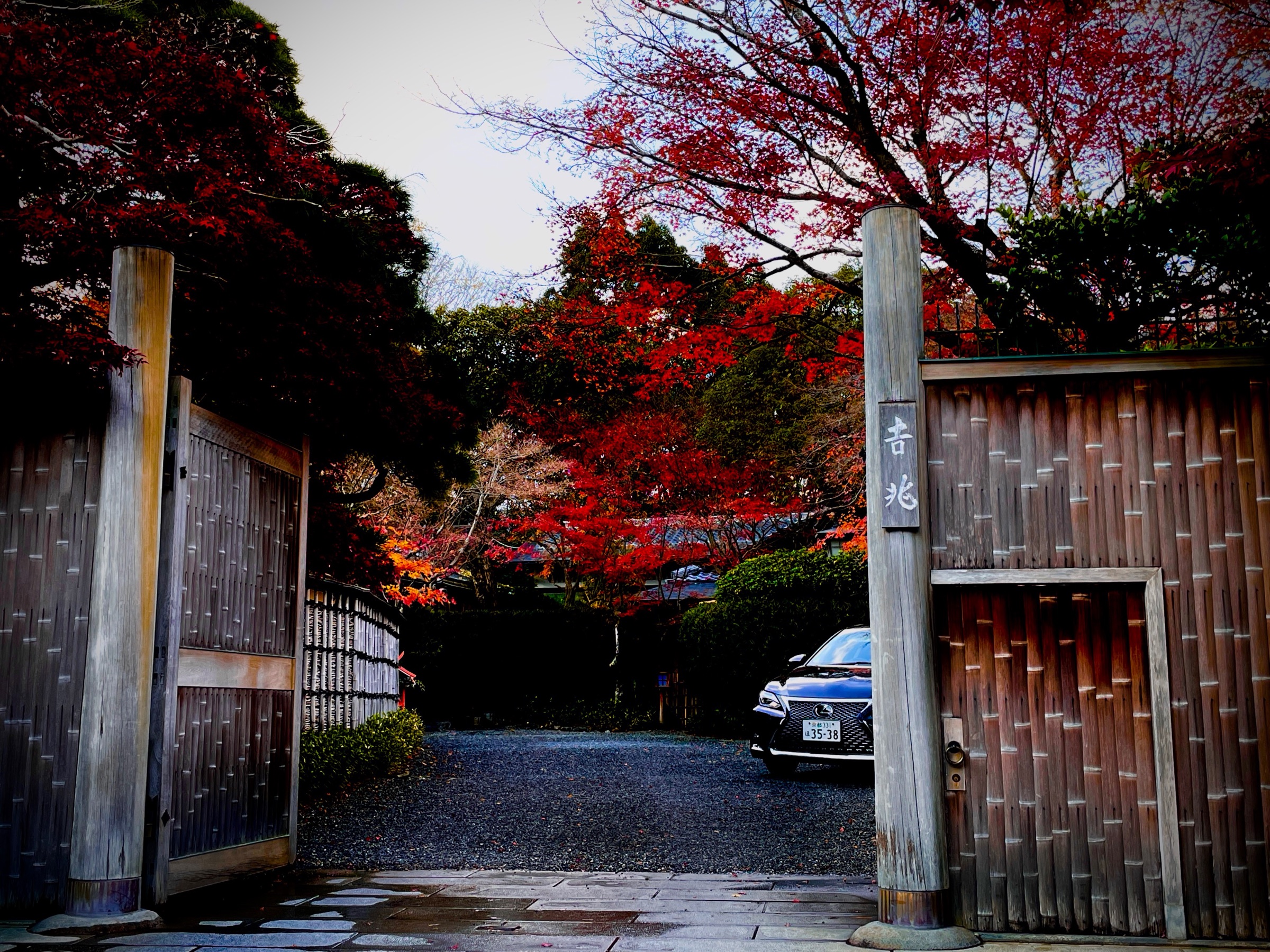
The restaurant sits quietly in Higashiyama, apart from the Kitcho flagship in Arashiyama. The flagship had impressed us with its weighty, imposing frontage; HANA, by contrast, blends into its street while keeping a fresh, clean presence of its own. We were finally going to experience the world of the Kitcho group, and our expectations rose accordingly.
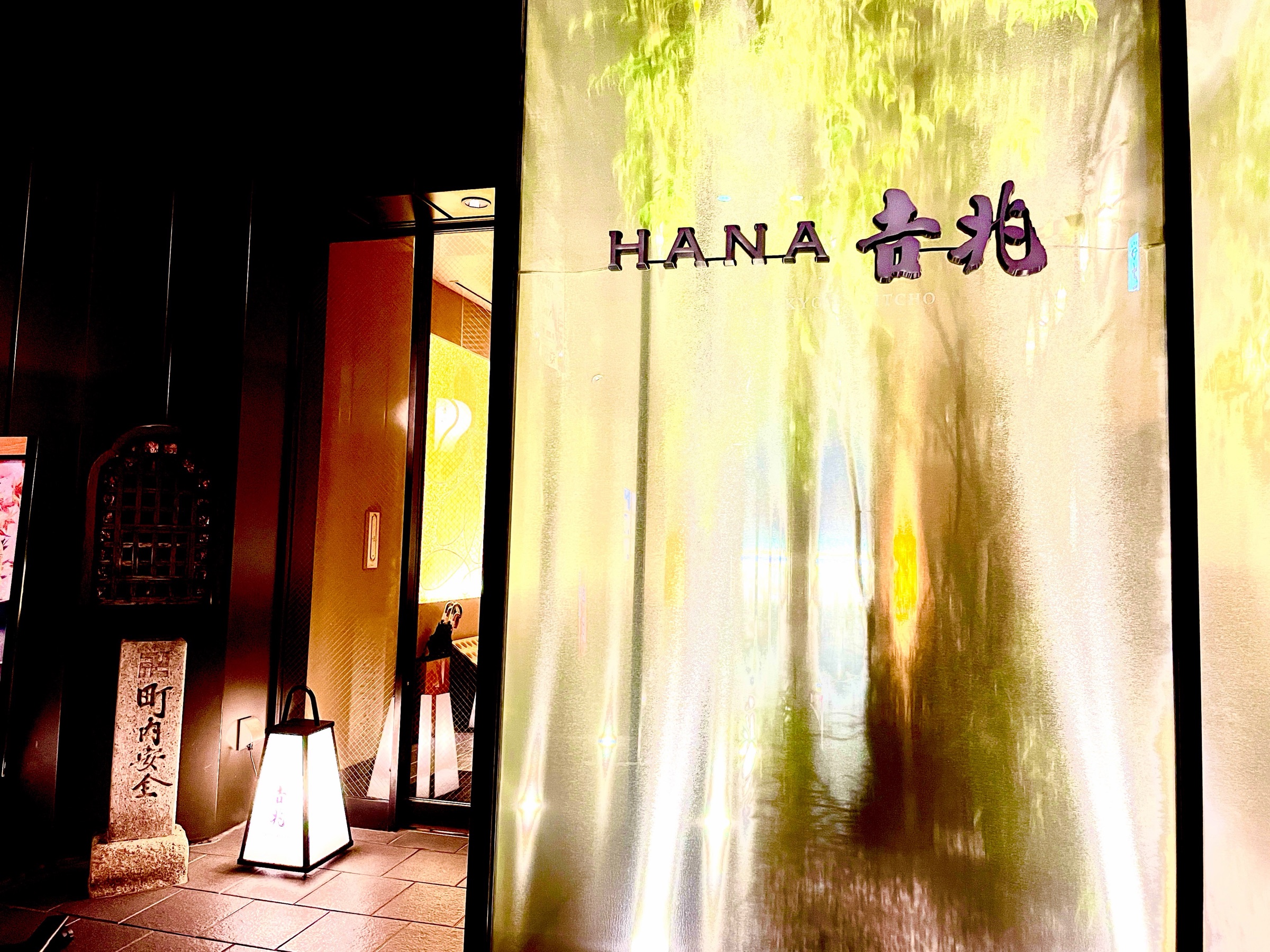
Private rooms, and a welcome in a bowl
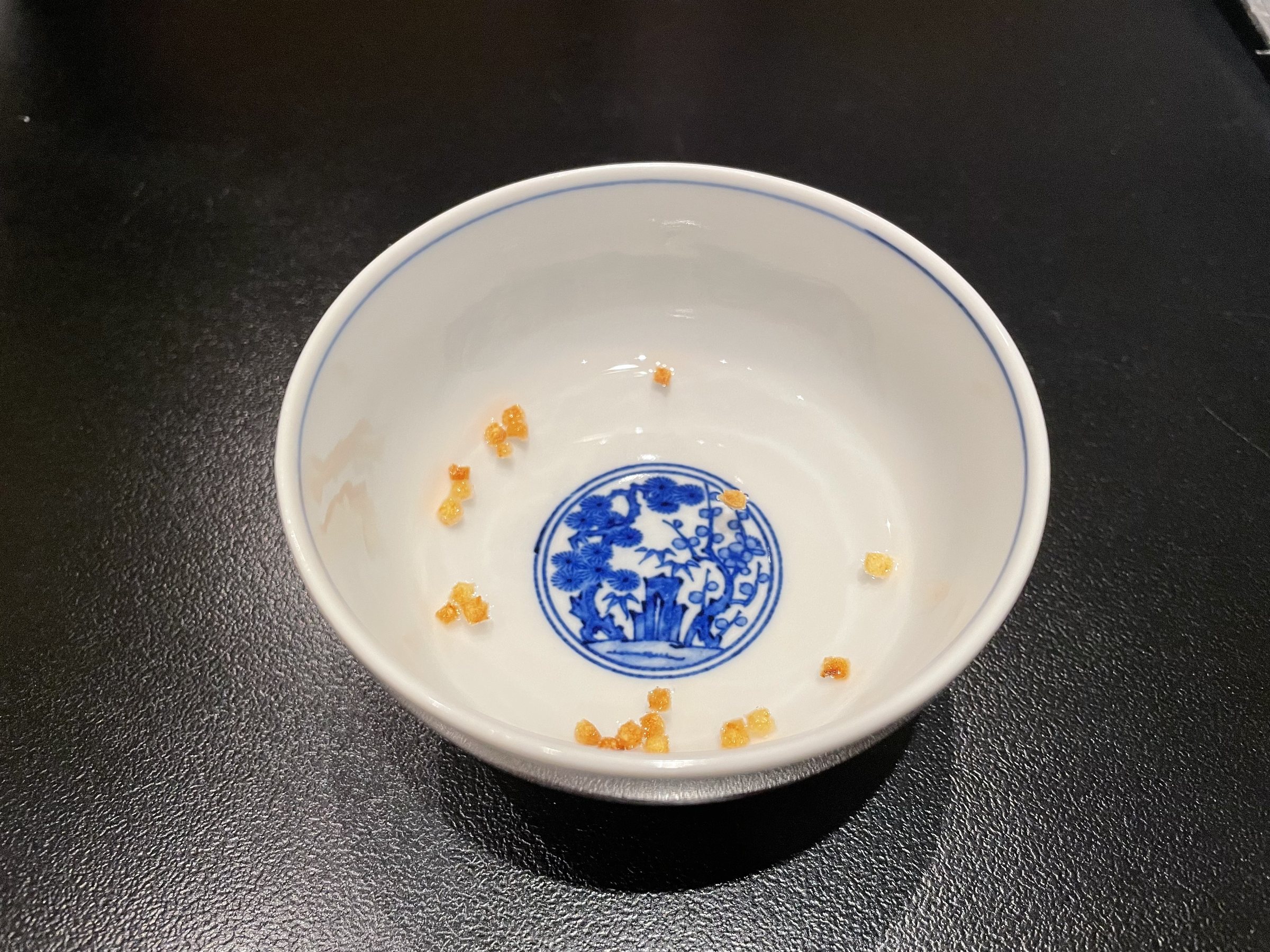
Apart from a few counter seats, every table is in a fully private room. The moment we were shown to ours, a server set down hot towels with brisk, easy timing. The first thing placed on the table was a bowl of lightly salted hot water with toasted grains floating on the surface: a simple welcome, but one that made an impression from the very start.
The staff’s polite language and measured movements drew us into the restaurant’s world almost without our noticing. Already enjoying ourselves, we turned to drinks and took our server’s recommendation: a sake from Ishikawa Prefecture, served cold.
Wet chopsticks, and other courtesies
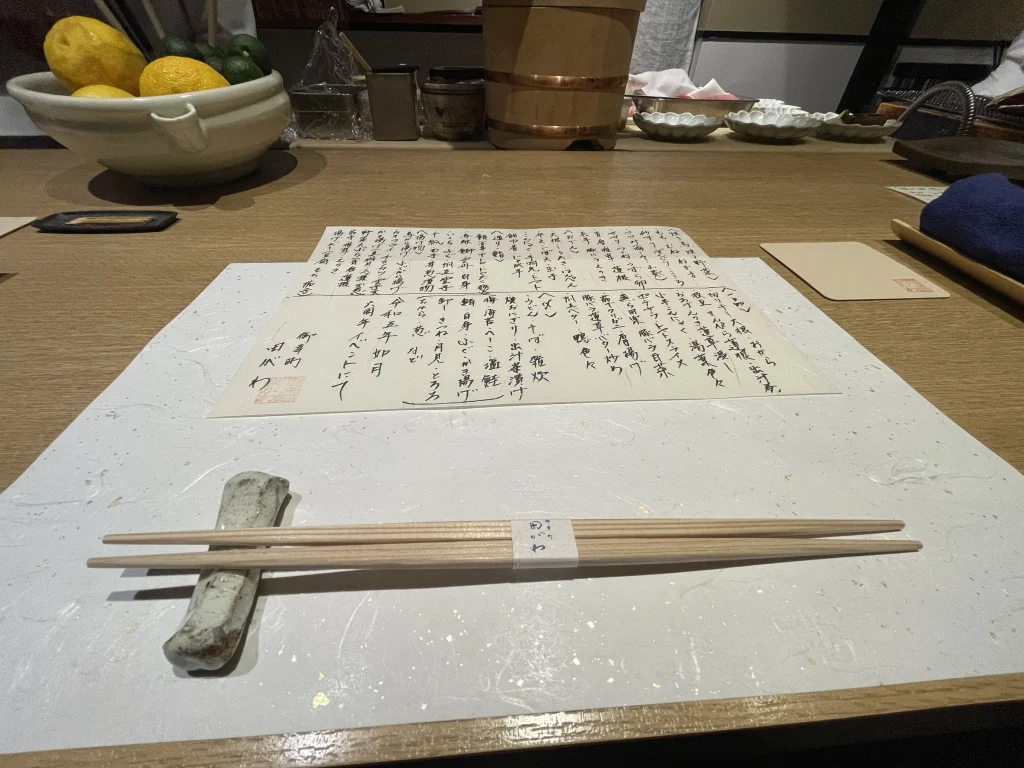
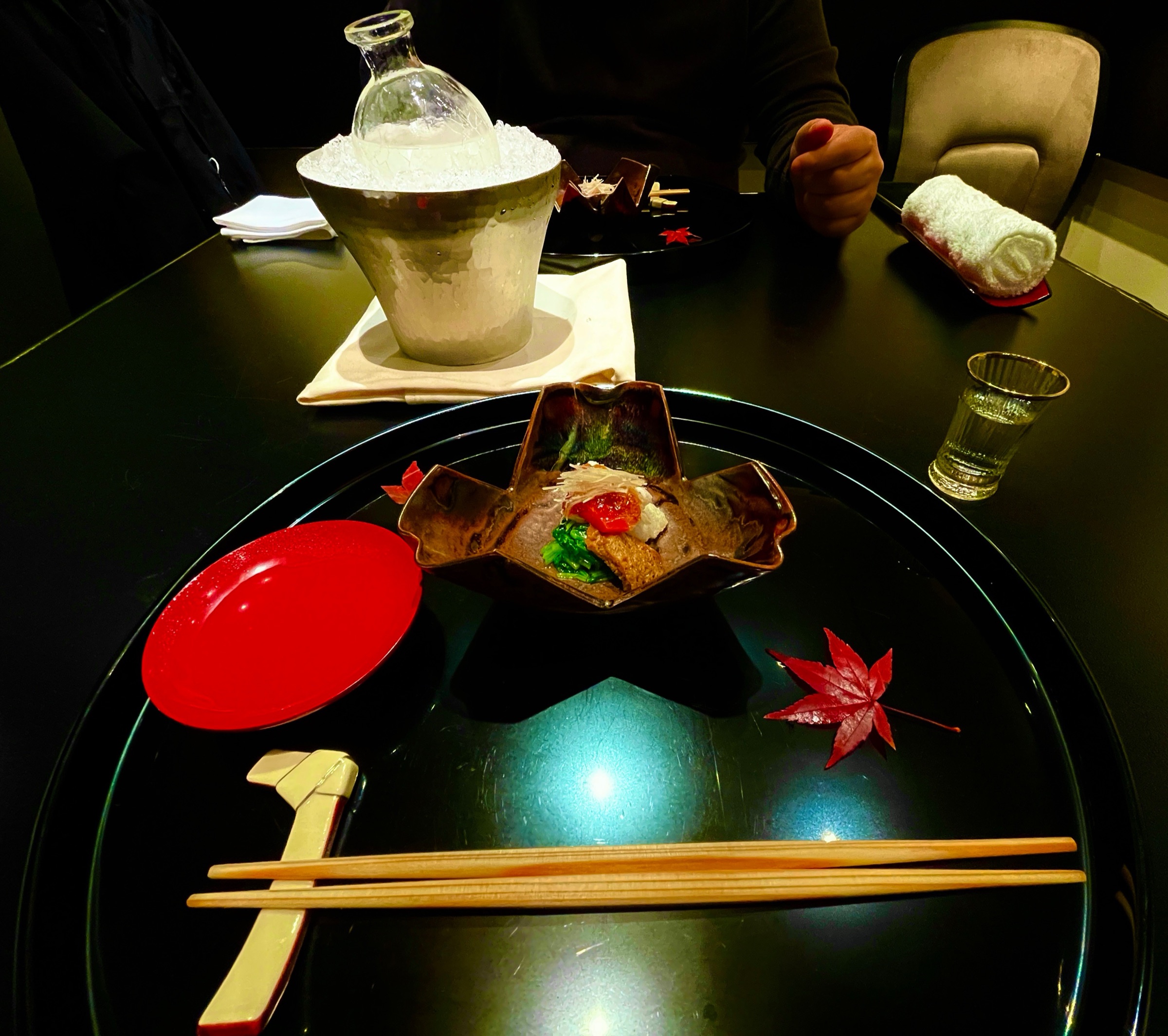
The table was dressed for autumn, in colors that stand out against black lacquer and that Japanese diners love. Visitors from abroad would surely be delighted by them too. When we picked up our chopsticks, we found they had been moistened, a refined piece of Japanese table etiquette. Nurebashi, or “wet chopsticks”, are dampened by the kitchen so that the wood neither lends its own flavor to the food nor soaks up too much liquid when you eat soups and broths. At the most formal level, there are even conventions for exactly how far the tips should be wetted, and the chopsticks we were given clearly followed them.
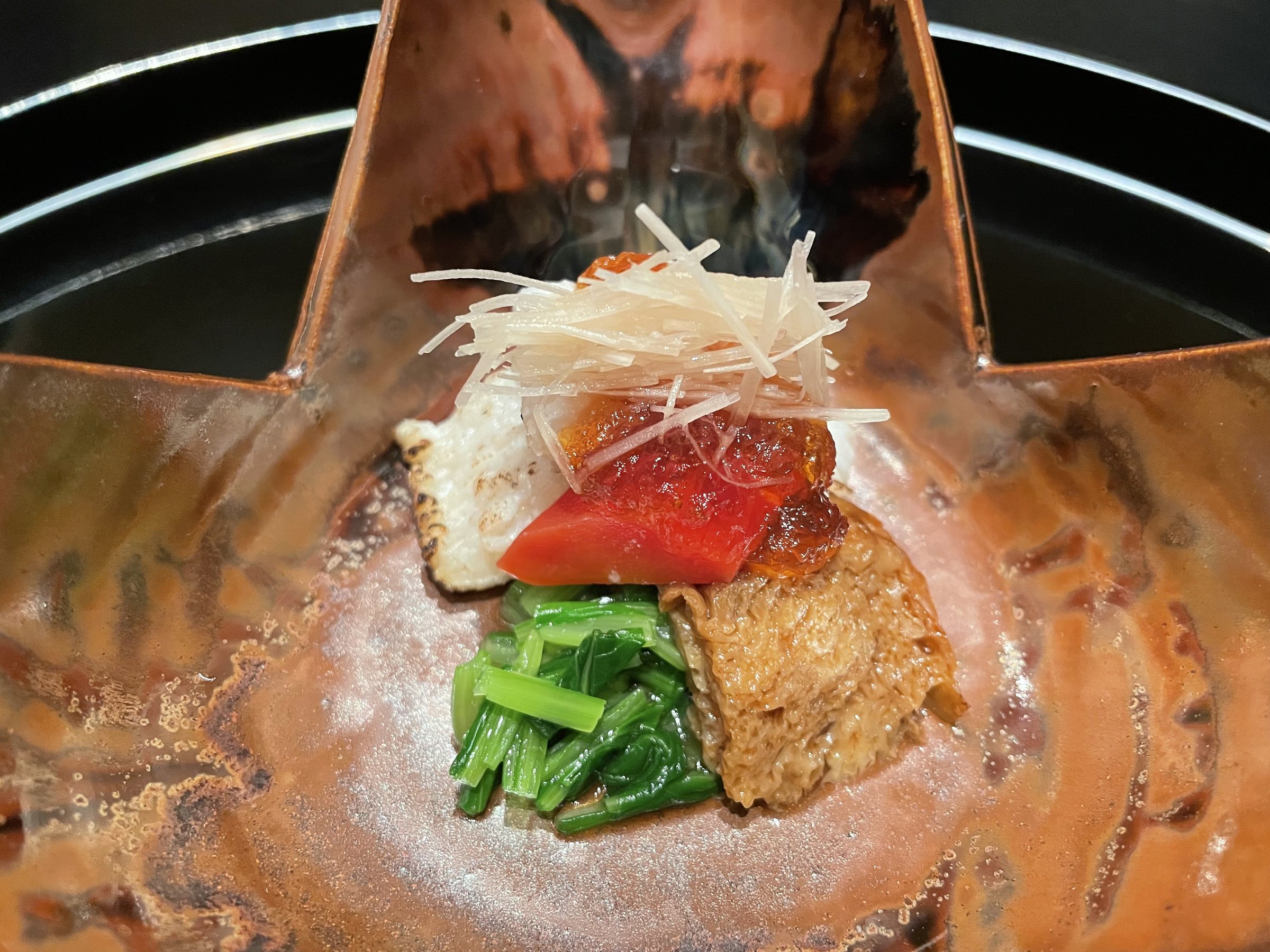
The first course was a sunomono, a vinegared dish served as the mukozuke: crisp leafy greens with a vinegar jelly and wheat gluten (fu) with a satisfyingly firm bite. What stayed with us was the faint scent of dashi and the deliberately gentle seasoning. Seeing that kind of skill from the very first dish only raised our expectations further.
The sashimi, and a different face of the sea
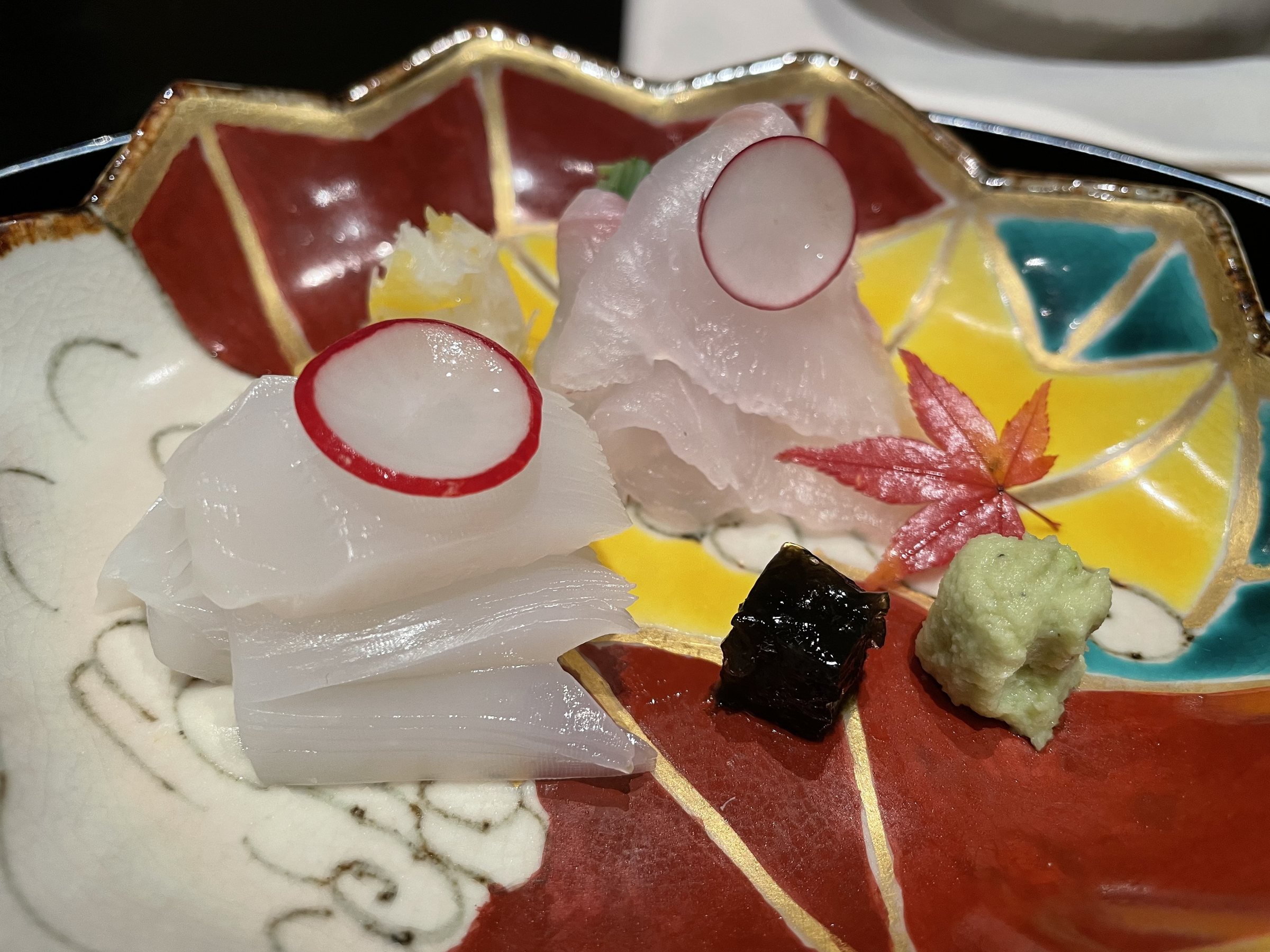
The sashimi was spear squid and sea bream, both cured in kombu. The squid had been scored with perfectly even decorative cuts, which gave it a pleasant bite as well as making it beautiful to look at. The kelp had drawn the moisture from the sea bream, leaving it with the deeper flavor of gentle aging.
Alongside wasabi that tasted as if it had been grated moments earlier came a small mound of nori tsukudani, seaweed simmered in soy and mirin. Eaten together with the fish, it coated each slice in the scent of the shoreline. It showed the sashimi in a different light from soy sauce.
An autumn platter
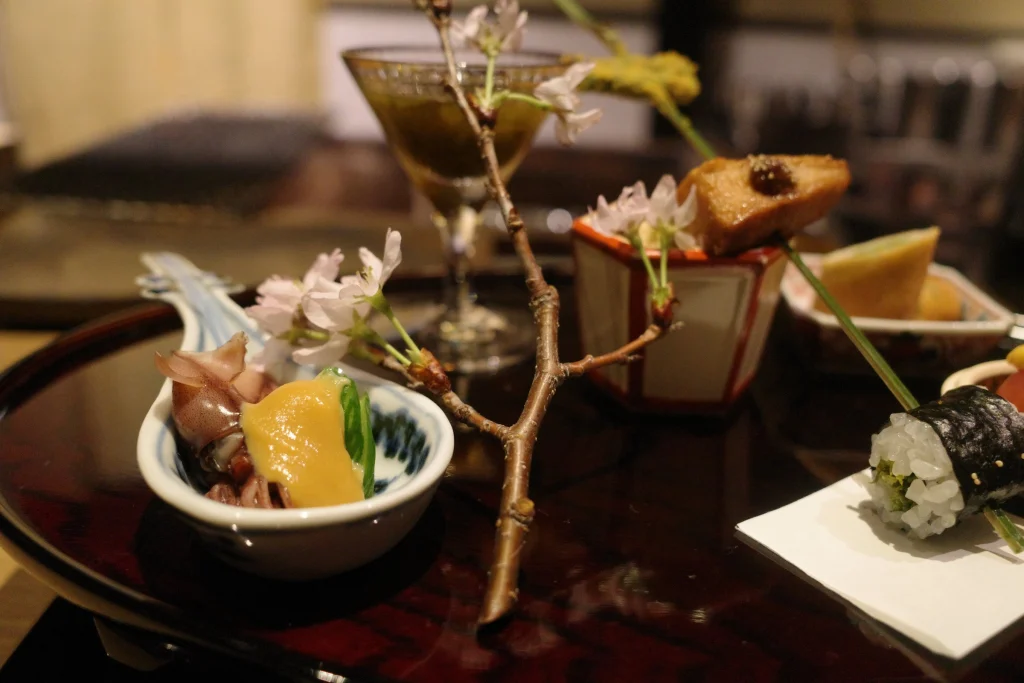
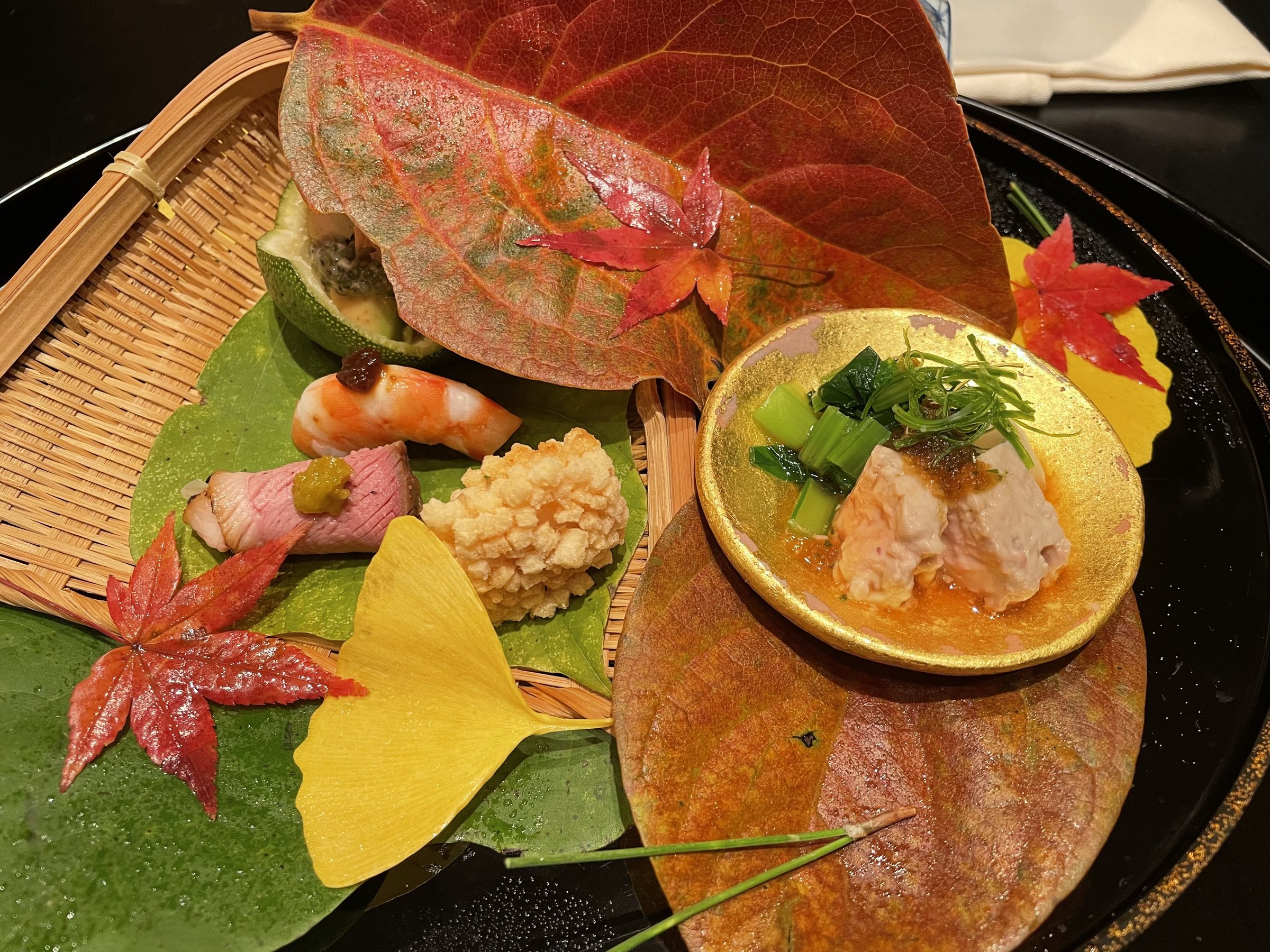
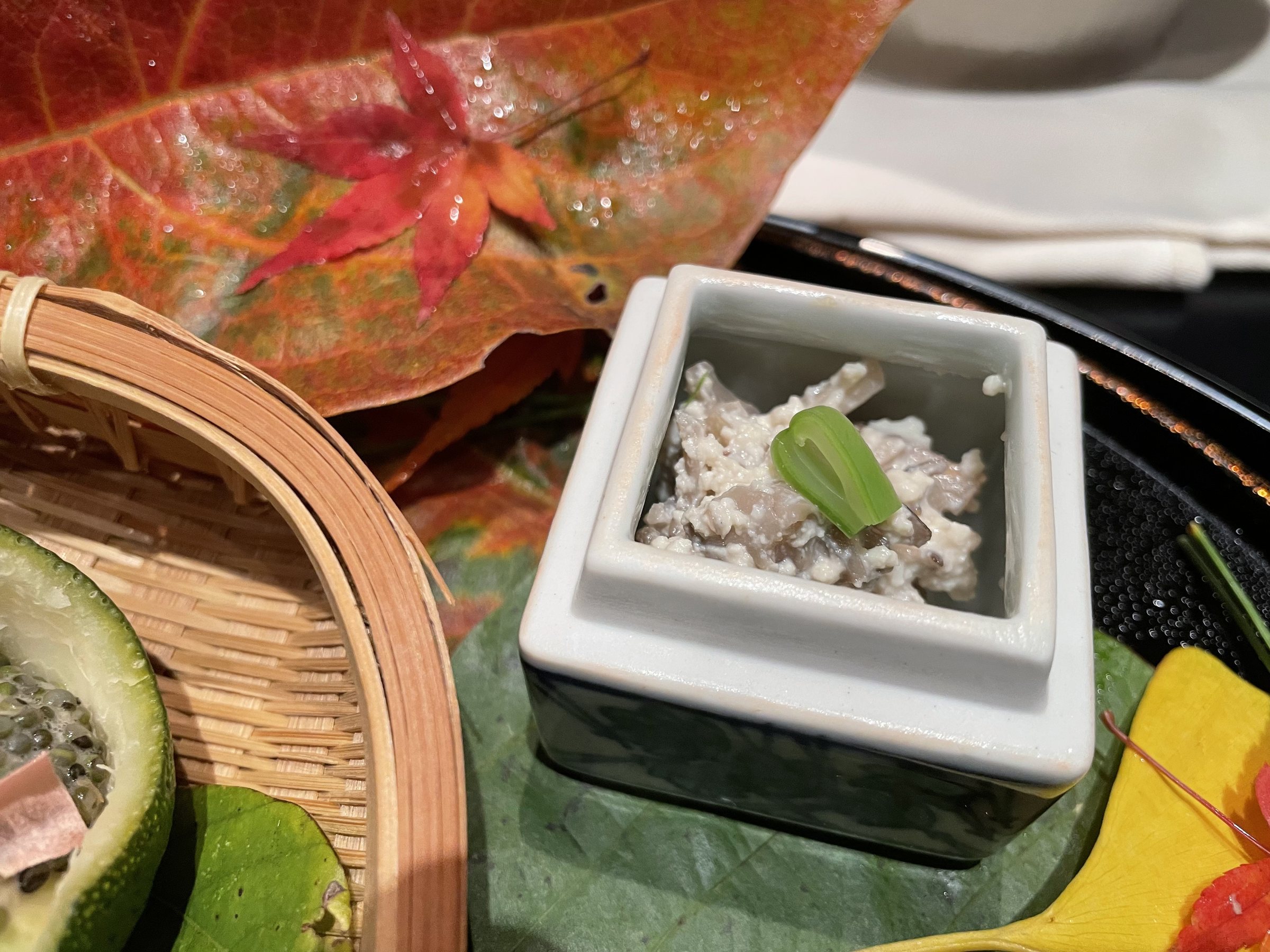
In the square dish at the top sat maitake mushrooms in shira-ae, a tofu dressing. The flavor was so complex that we could not tell how many seasonings were involved, and we were amazed that such a humble ingredient could be made this good. Something beyond the white miso and dashi seemed to be holding the whole thing powerfully together.
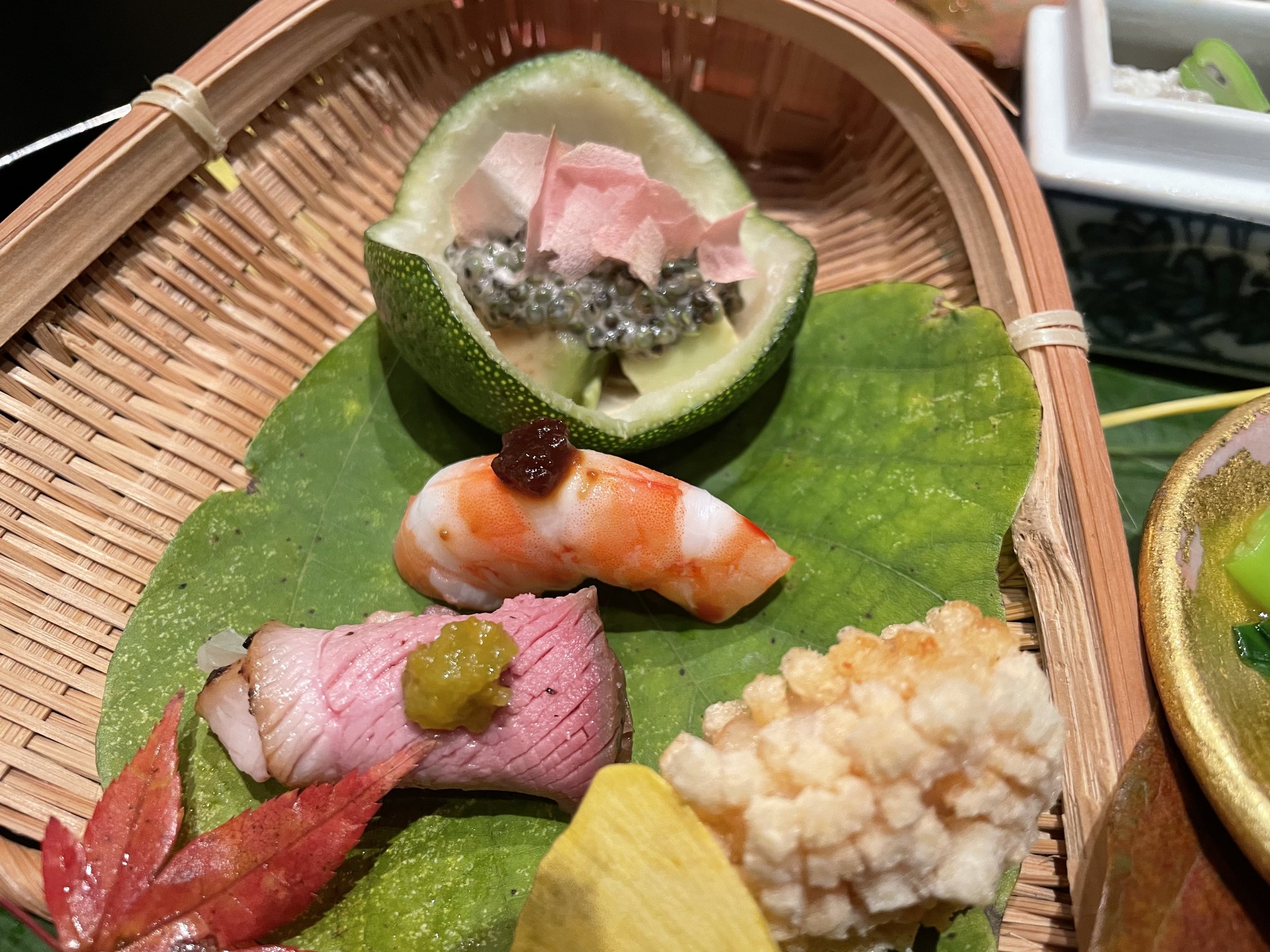
The battered piece was scallop, served with duck accented with yuzu kosho, and beside them a prawn that, we were told, “was in the tank until a moment ago.” A dish of tonburi, the seeds of the summer cypress known as “mountain caviar”, gave the palate a cool pause, and we kept returning to it between sips of sake.
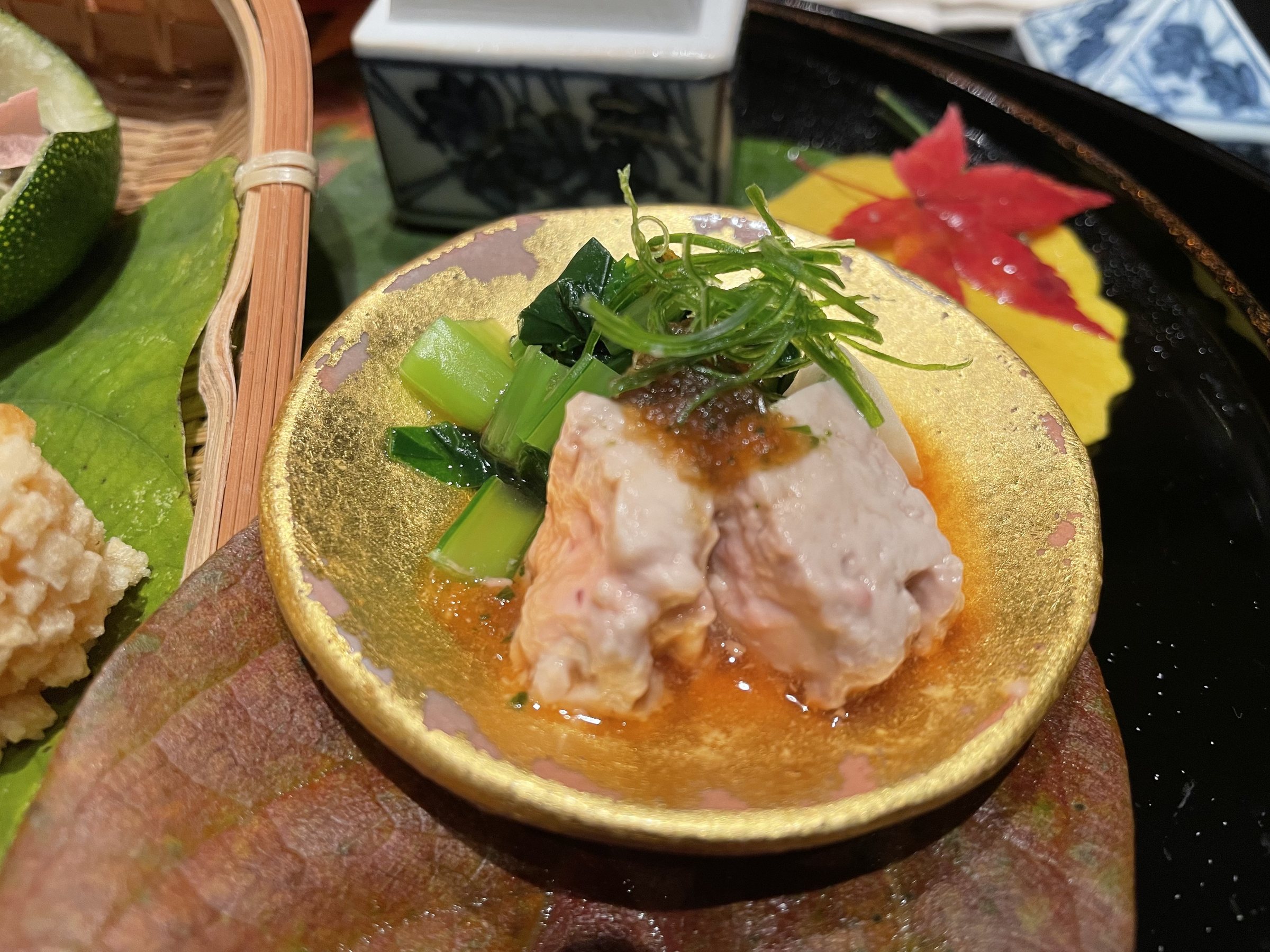
The ankimo, monkfish liver, presented in a gold dish, was another surprise. There was none of the fishiness or distinctive odor we had braced for, only a pure, creamy richness. Needless to say, it went beautifully with sake, and we found ourselves ordering another.
Crab, in a single spoonful
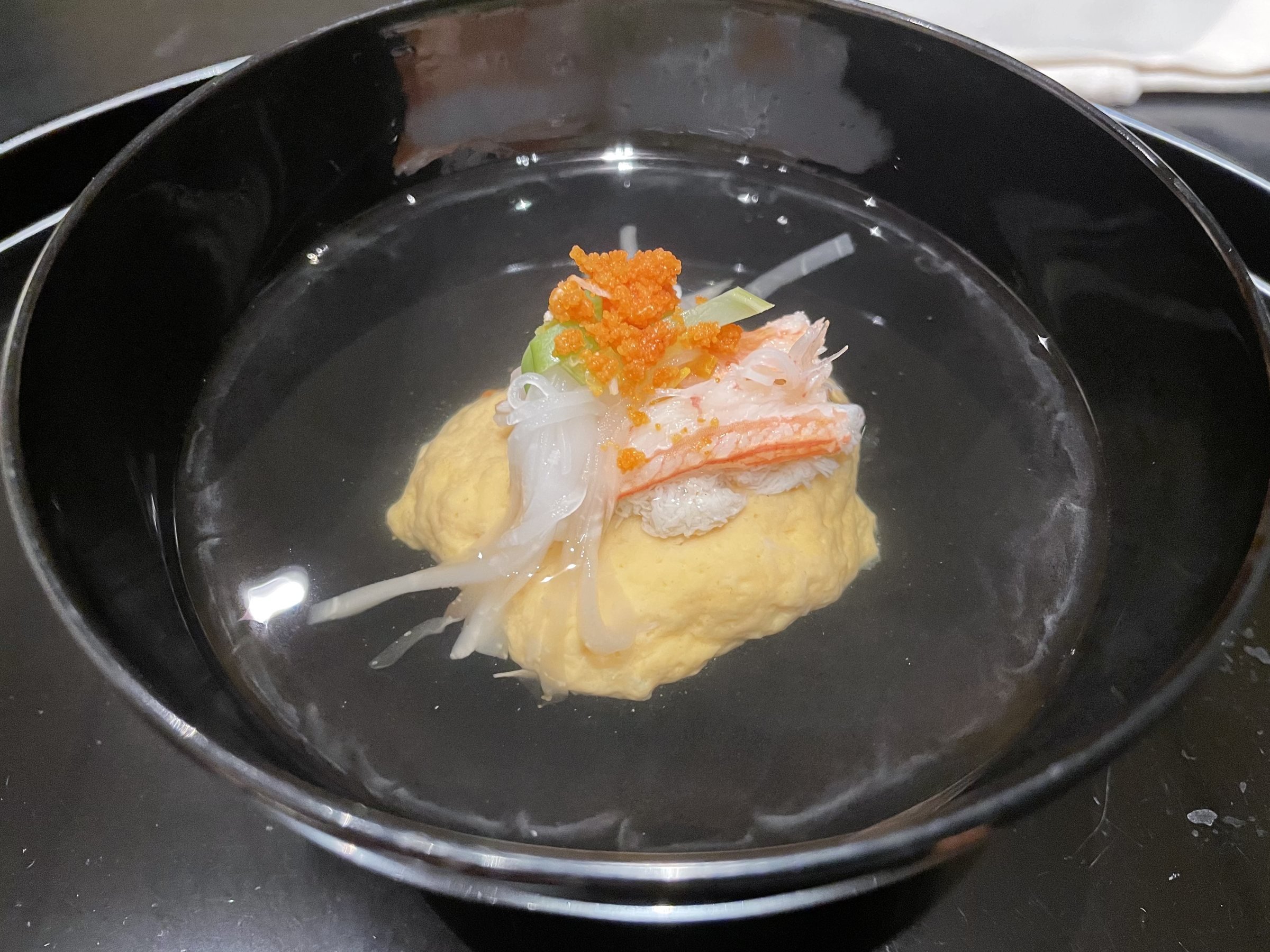
Next came the wanmono, the soup course. Perhaps our ideas about the order of a Japanese meal had been a little too fixed.
Snow crab goes by different names in different regions; here it is also called seiko-gani or Echizen-gani. The portion of crab was small, but its impact was large: every part of the crab in a single mouthful. Beyond the crab itself, even the roe placed on top melted into the dashi and dissolved on the tongue. The broth left in the bowl at the end became a superb clear soup that carried the echo of the whole dish.
Courses arrived more quickly than we had expected, with no awkward pauses, as if the staff were watching our pace closely. Each dish seemed to be set down the moment it was finished. Preparation done in advance explains some of it, but the timing, which never left us waiting, genuinely surprised us.
A ginkgo nut from the old tree
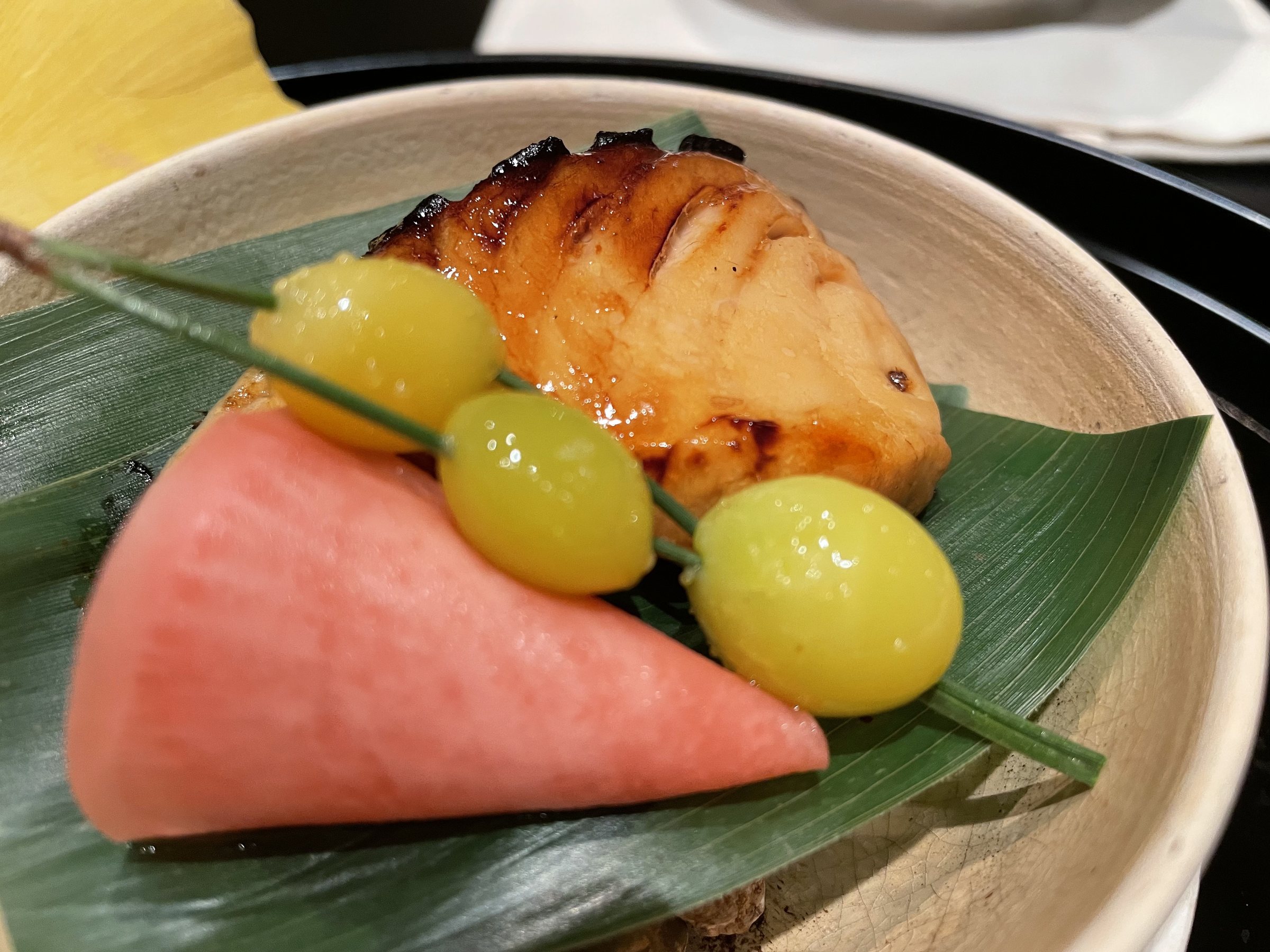
With the sawara (Spanish mackerel) grilled yuan-yaki style came a single large ginkgo nut, gathered that morning, we were told, from the great tree at the Kitcho flagship: an auspicious gift.
Hearing the story of where, when, by whom and how an ingredient was gathered sets the imagination running, and the story itself becomes a kind of seasoning. It happens often when eating Japanese food. Elsewhere, we once had a dessert brought to the table with the words “strawberries picked this morning from a nearby field”, and we savored it all the more for knowing it.
In the world of kappo cuisine, the type of fish served is itself one of the ways you feel the season. The character for sawara contains the character for “spring”, so we had assumed it was a fish of early spring. Served here in midwinter and marinated in sweet sake lees, it had just the right firmness and richness, and we were entirely satisfied.
Takiawase: the art of the Kyoto simmer
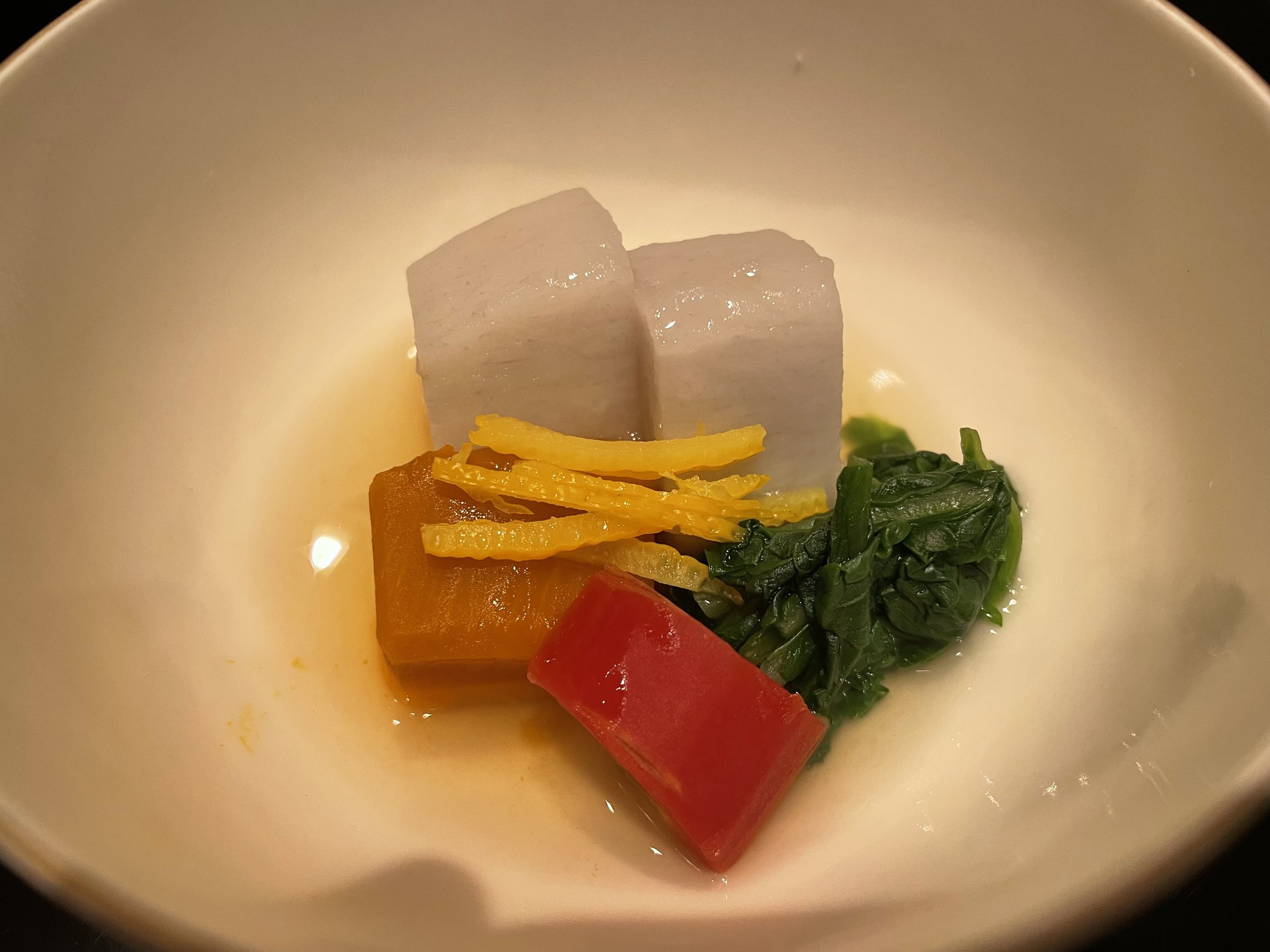
No meal in Kyoto feels complete without takiawase, known locally as taitan: a dish of simmered Kyoto vegetables in which the cook’s skill shines. Taro, Kyoto carrot, leafy greens and kabocha squash each had a subtly different flavor. Simmering each ingredient separately and combining them only at the end is the basis of Kansai-style simmered dishes.
Since each vegetable tastes different, some variation is only to be expected. Yet every morsel in that small bowl tasted as if it had been seasoned anew, and we were truly impressed by the technique and the sensibility behind it. The dashi was pale yet had real presence; we were told it was blended from strongly aromatic bonito flakes that include the dark chiai flesh, with Rishiri and Rausu kombu.
The world of dashi is endlessly varied in both ingredients and methods. Simply asking, with a slightly knowing air, whether the bonito includes the chiai can be enough to start a lively conversation with the chef.
Kujo negi rice
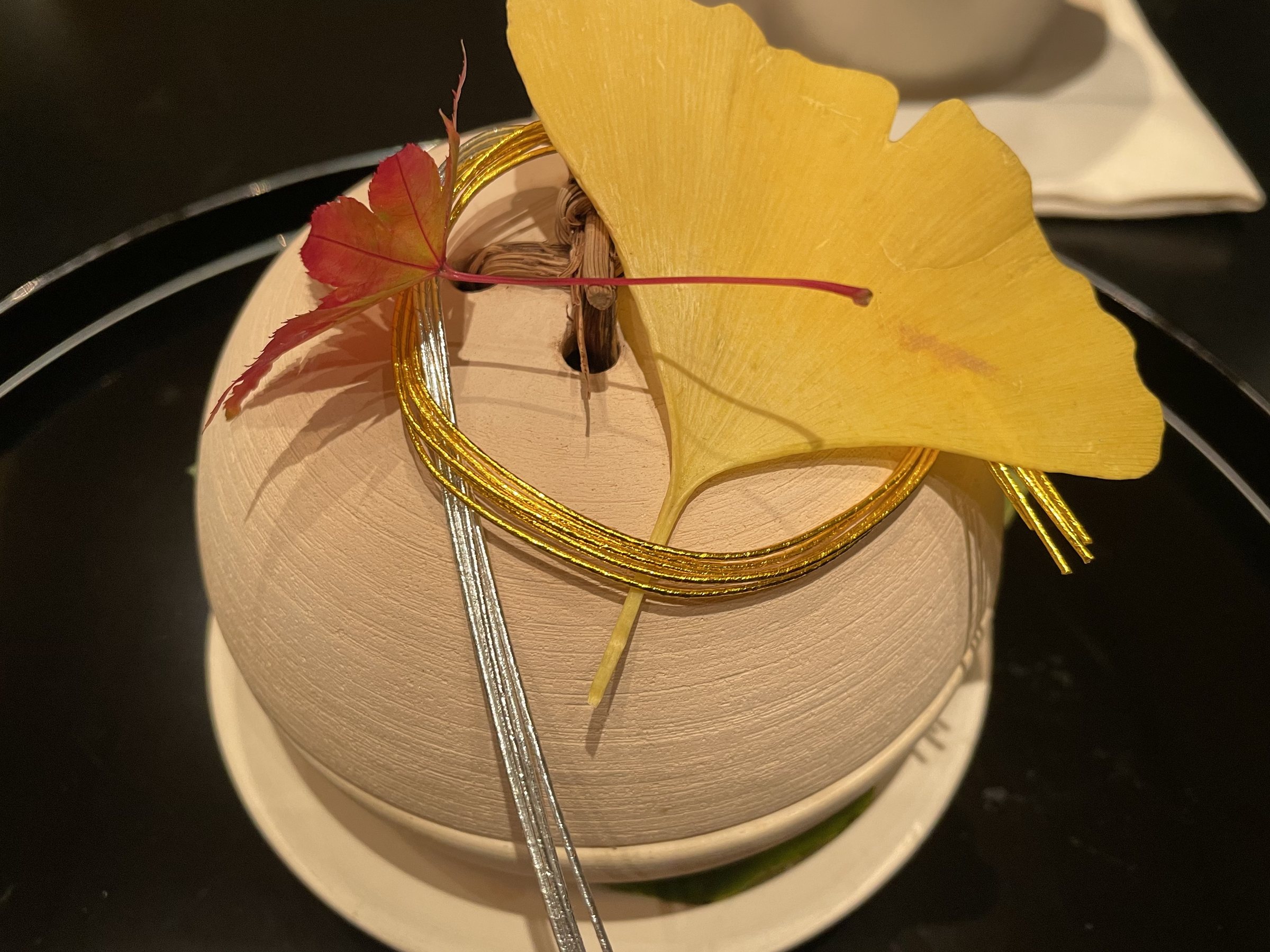
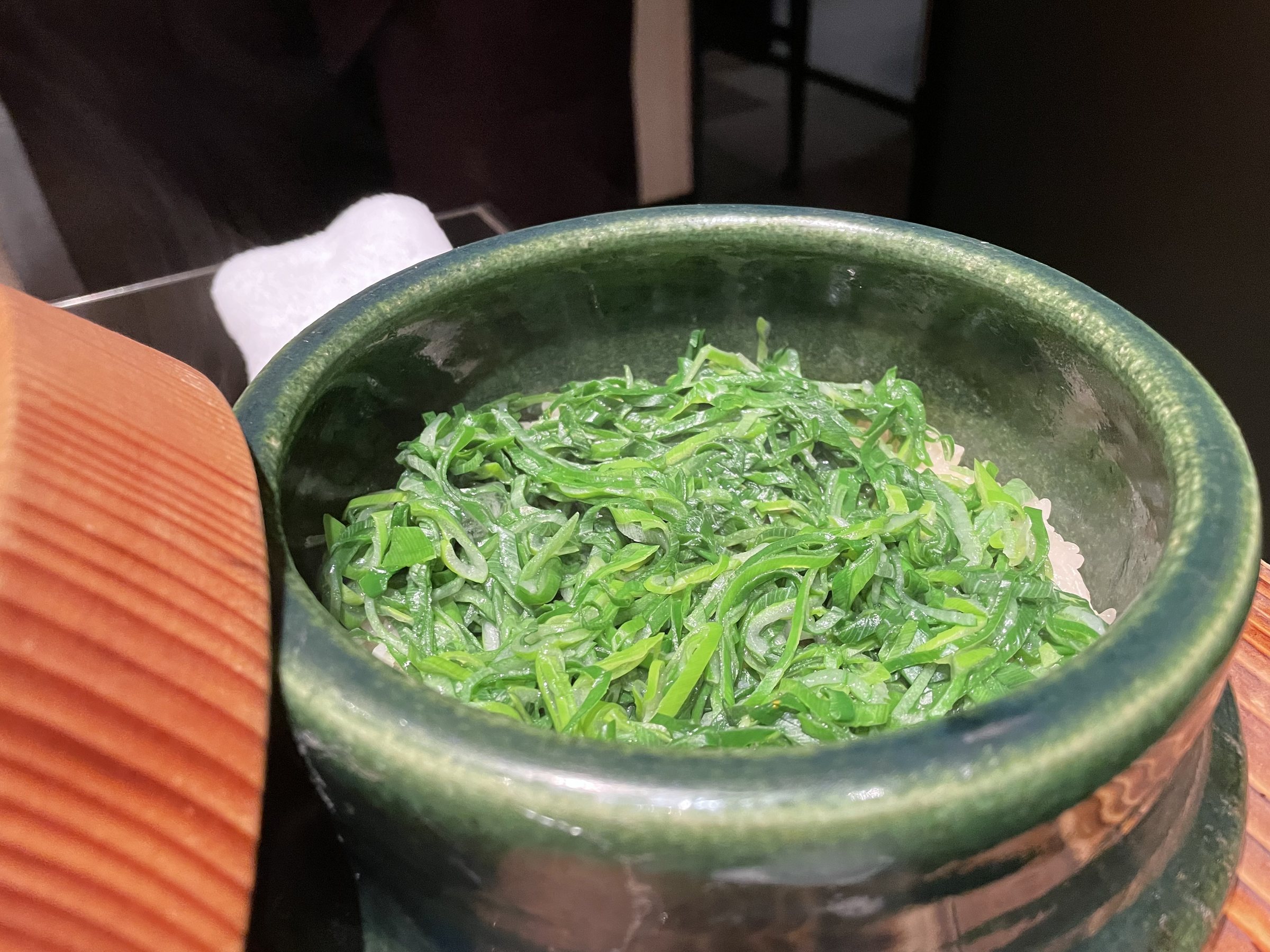
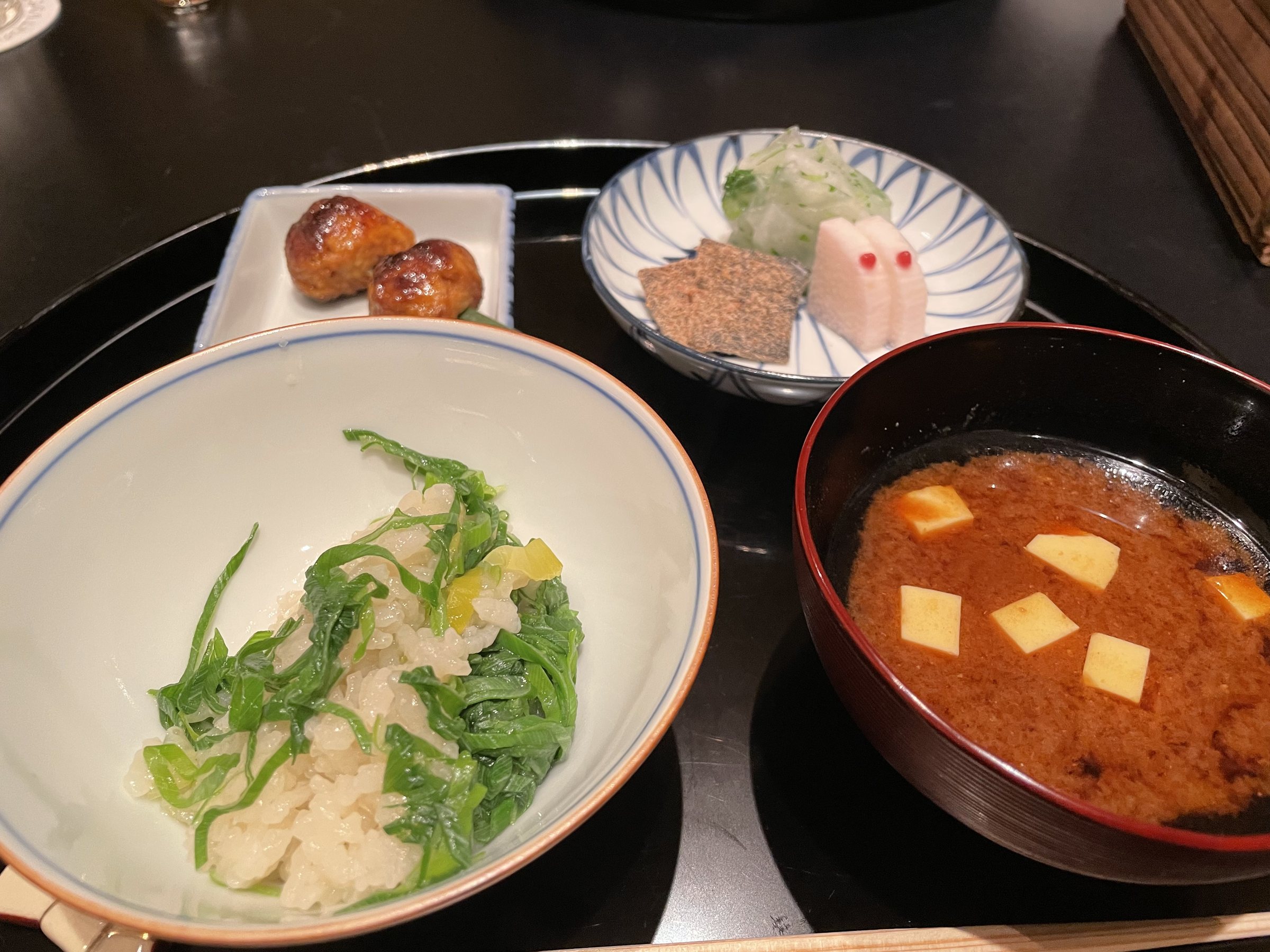
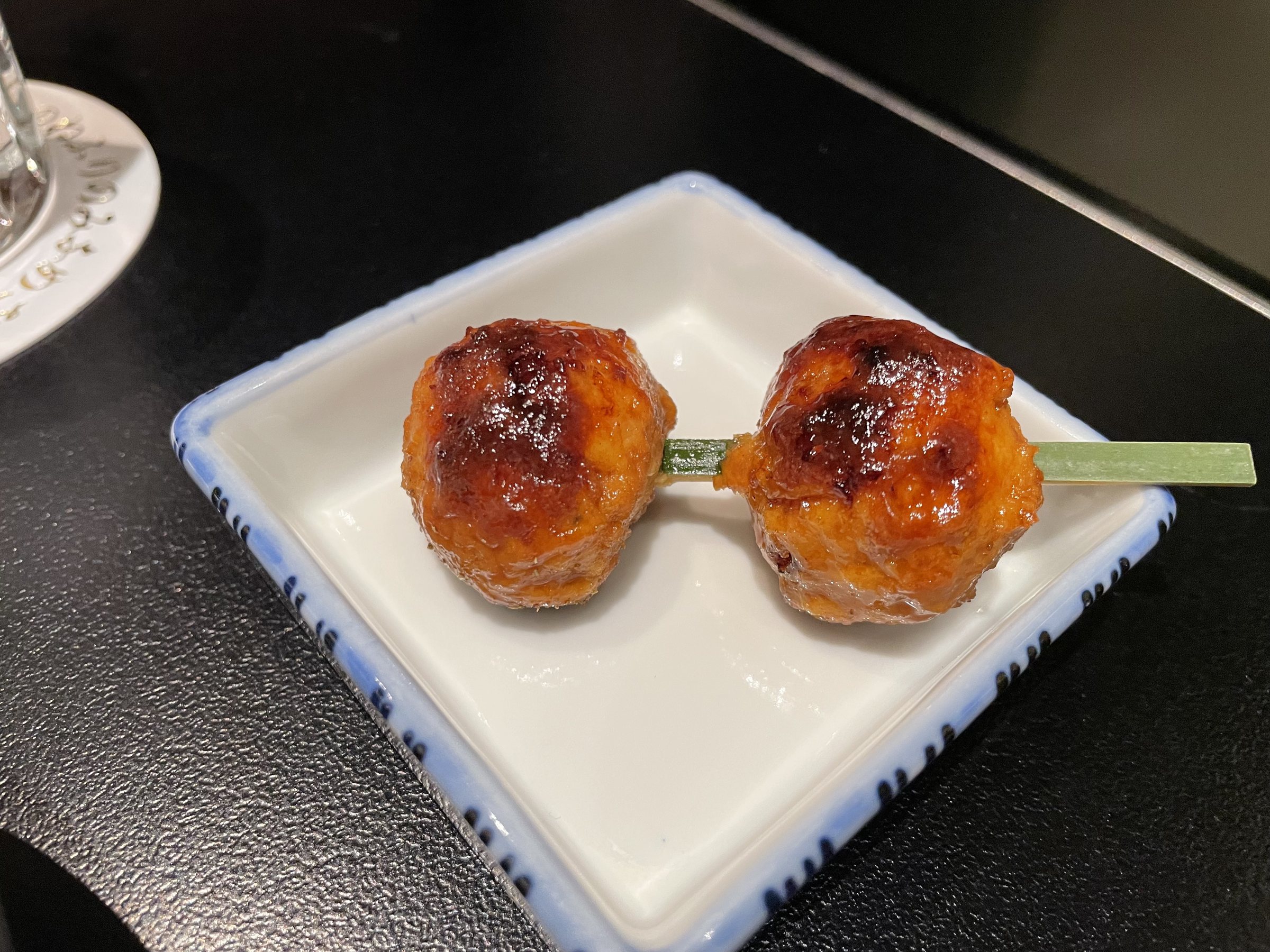
When the lid of the earthenware pot came off, the aroma of Kujo leek and dashi filled the air at once. This was our first taste of rice cooked with Kujo leek. Only the bright green tips of the leaves are used, so it is a pleasure to look at as well, and it came with duck tsumire, small minced-duck dumplings. A small twist and a well-chosen pairing, and the combination was superb. Alternating between red miso soup and Kyoto pickles, we emptied the pot.
We learned that the rice is cooked with a generous amount of second dashi so that it can hold its own against the leek.
Every dish was lightly seasoned, yet each stayed clearly on the tongue after we had swallowed it. That balance was remarkable.
Dessert, and a curious texture
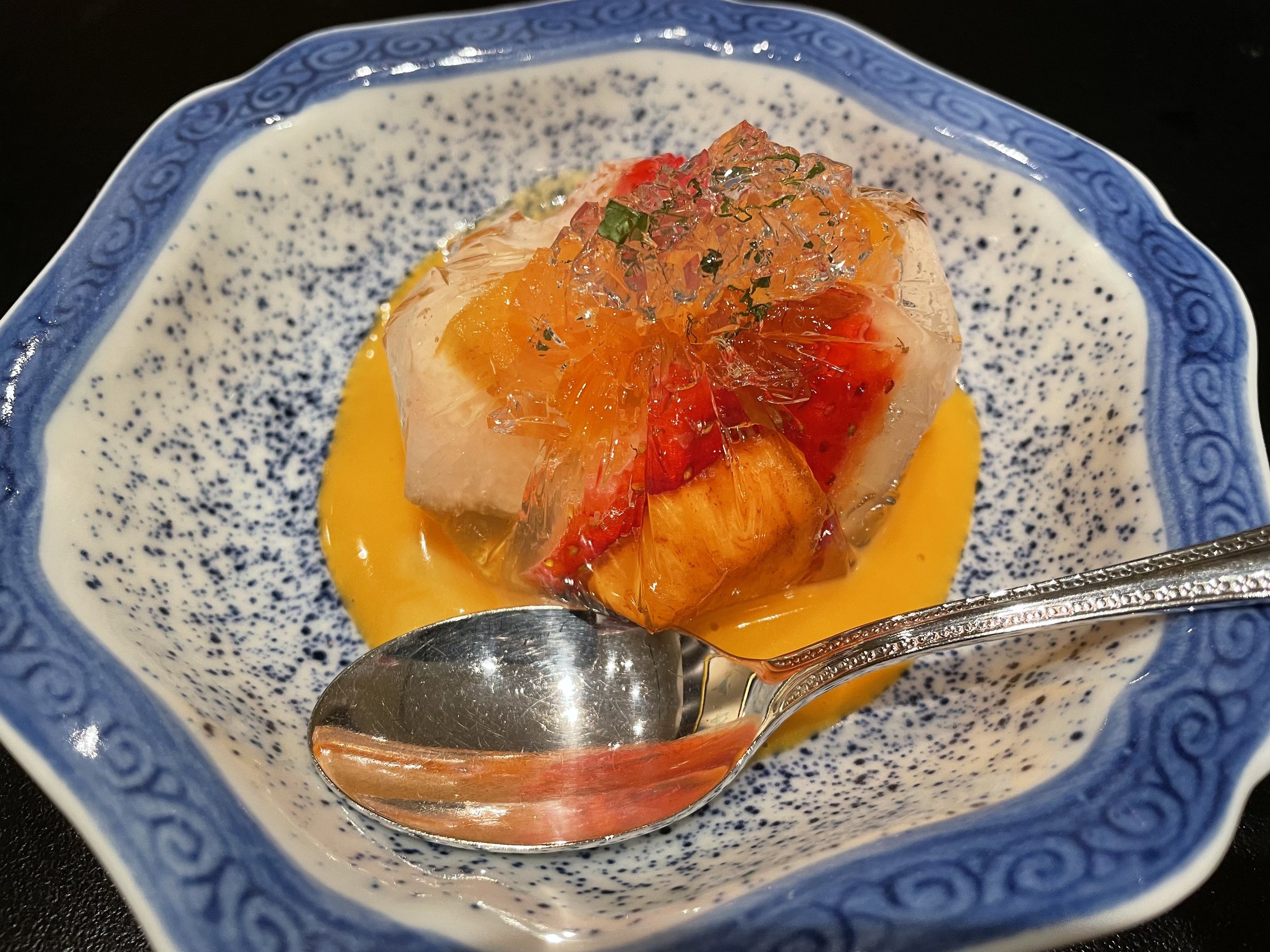
To finish, seasonal fruit set in jelly. The fruit had been carefully prepared and was fresh rather than sharp, and the custard-like sauce underneath made it deeply satisfying. The sauce had a slightly grainy texture, which set us wondering whether an unusual sweetener was involved or whether the effect was intentional. That we thought about it so much was, without doubt, down to the quality of everything that had come before.
A word from the kitchen
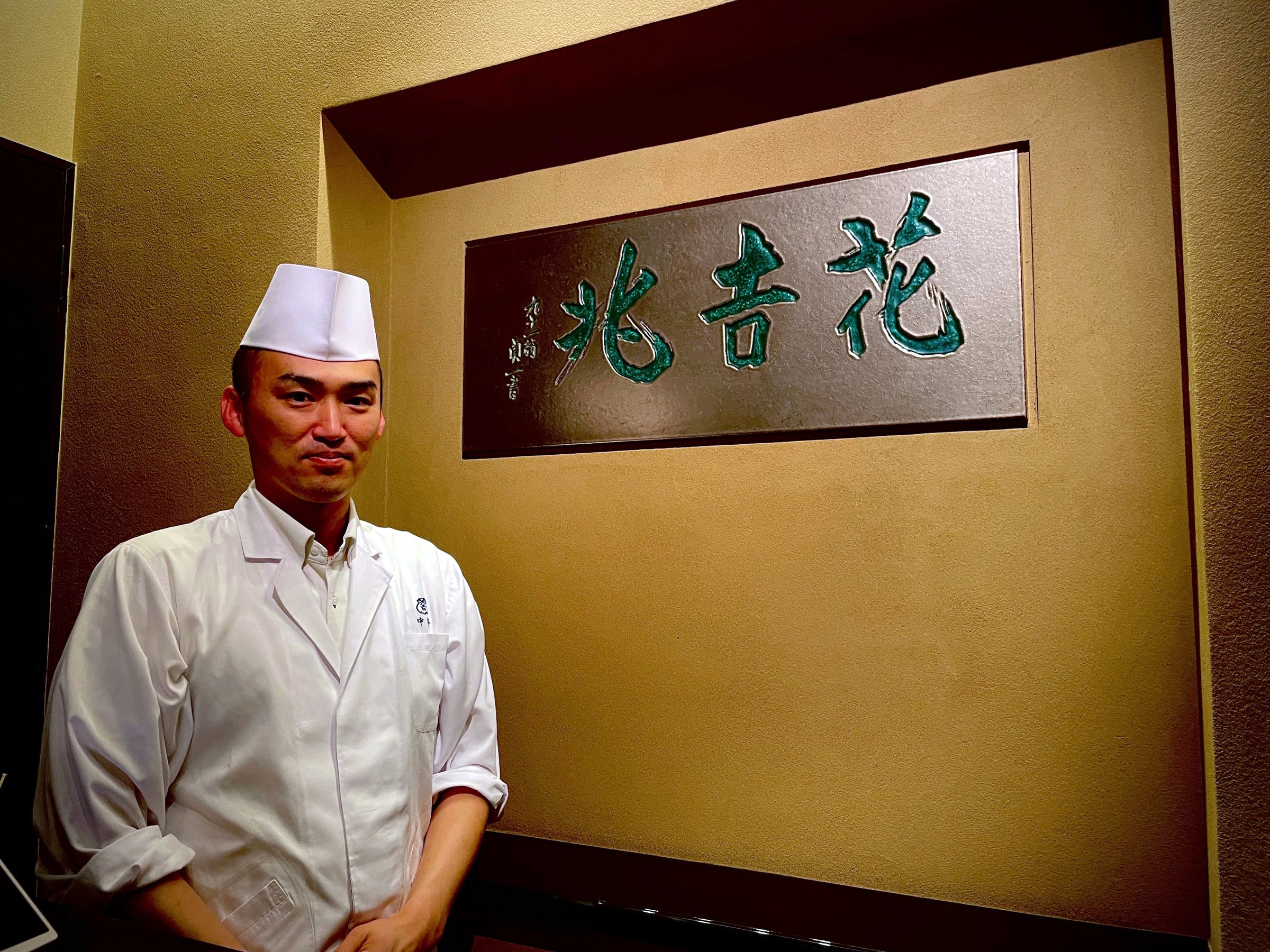
As we paid, the sous-chef came out specially to see us. At a restaurant of this standing, a chance to be thanked by one of the cooks at the end of a meal is rare.
We shared our thoughts on the dashi and the dishes, and were even bold enough to ask about the technique behind the rice. He was warm and easygoing, and happily agreed to a photograph. We left with the giddy feeling of having just met someone famous.
This review reflects a visit in late 2021. Menus change with the seasons; please confirm current details directly with the restaurant before visiting.