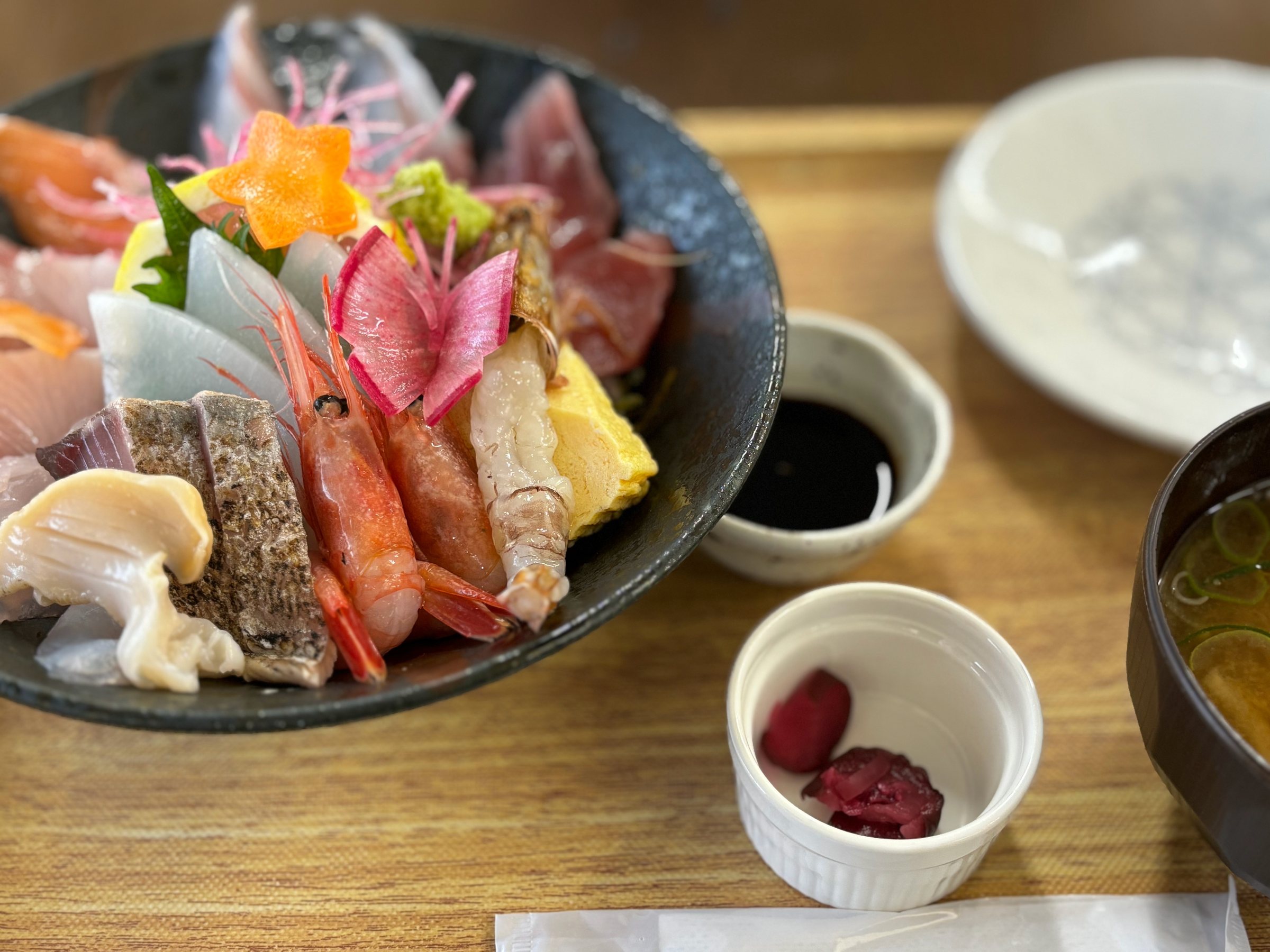
Our New Year’s Eve journey to the San’in coast began, as it should, with seafood. For lunch on the way we stopped at Hamasaka, at a place that seemed to announce itself as the lunch of the region: the San’in Kaigan Geopark Hamasaka no Sato. The bowl of seafood on rice was a sight in itself, piled so high that the toppings threatened to spill over the sides: prawns, squid, seared fish, white fish and, for color, slices of rolled omelet. Carrots cut into stars and daikon carved into butterflies showed how hard the kitchen works to delight its visitors.
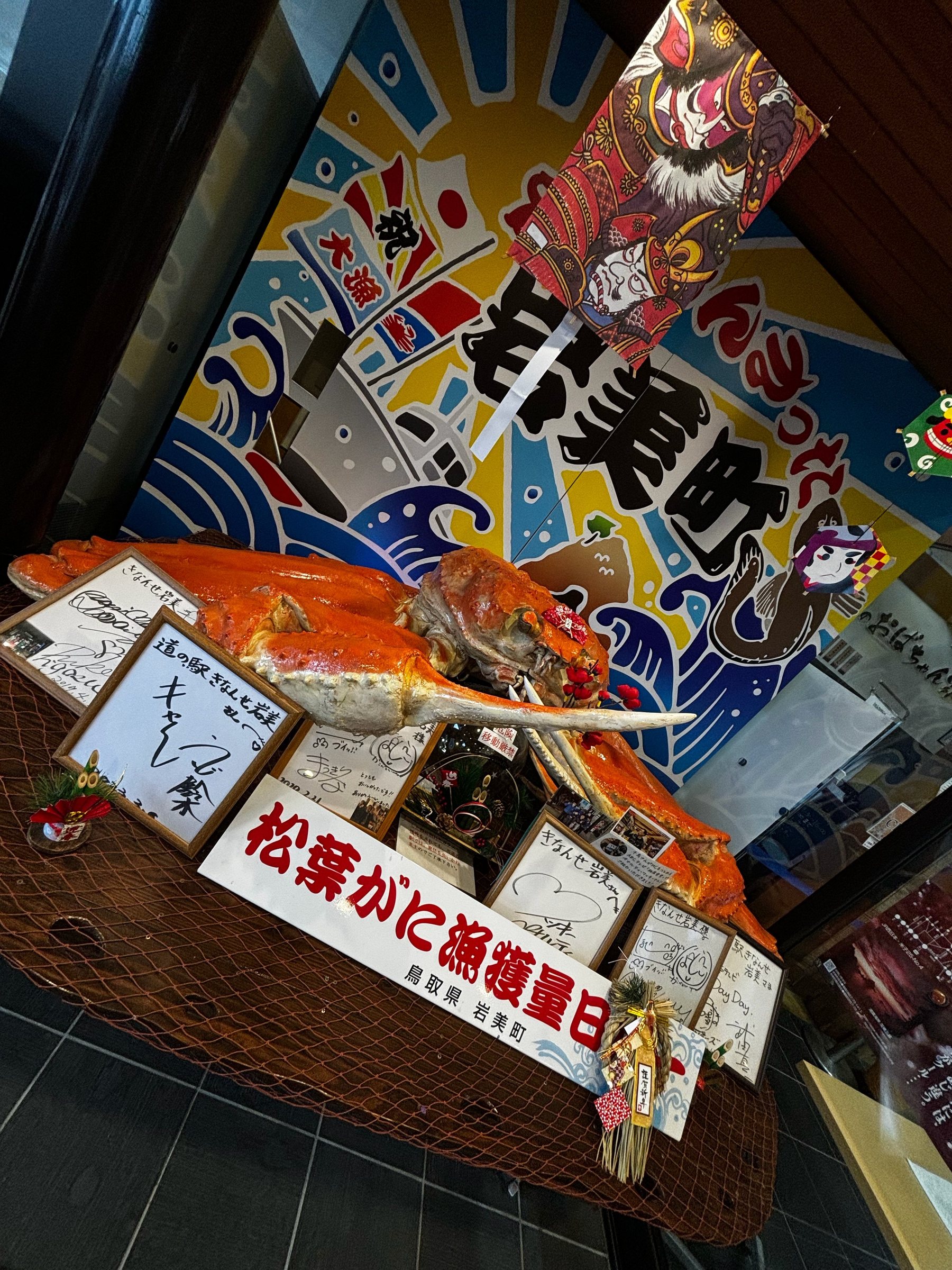
Nearby, a giant crab sculpture and a backdrop of colorful fishermen’s banners proclaim the area’s claim to the largest catch of matsuba-gani, the local snow crab, in Japan. As a way of telling travelers who have just eaten their fill of seafood that they have truly arrived in San’in, it works. For better or worse, it is a classic piece of provincial tourist-spot display, and standing in front of it brought on a wave of nostalgia.
A ryokan built on three traditional arts
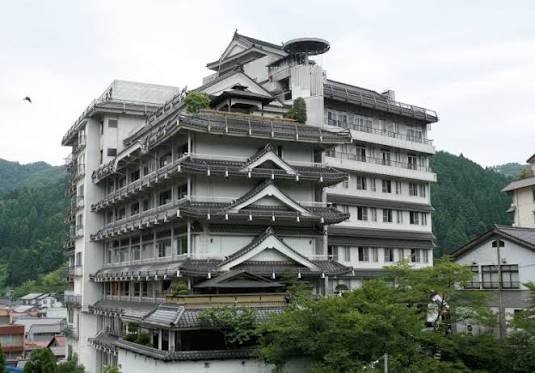
Hospitality at Asanoya rests on three of Japan’s traditional arts: sadō (the way of tea), kadō (flower arrangement) and kōdō (the appreciation of incense). Incense is given particular weight, in the belief that a culture of fragrance adds color to a stay and gives guests time to slow down and feel at ease. All of it is offered in the spirit of ichigo ichie, the idea that each encounter happens only once.
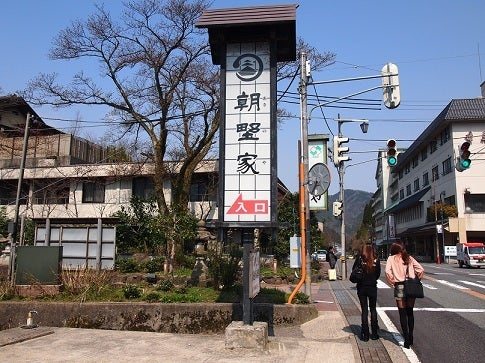
The Asanoya sign stands proudly in Yumura Onsen, and the name carries a history that reaches back well beyond the ryokan itself, to the Sengoku period of warring states. According to the ryokan’s own account, the local castle fell in 1581, when Hashiba (later Toyotomi) Hideyoshi’s forces invaded the province of Tajima. The descendants of its lord withdrew to a nearby village, left the warrior class and, so the story goes, went on to run lodgings and other businesses.
Corridors like a gallery
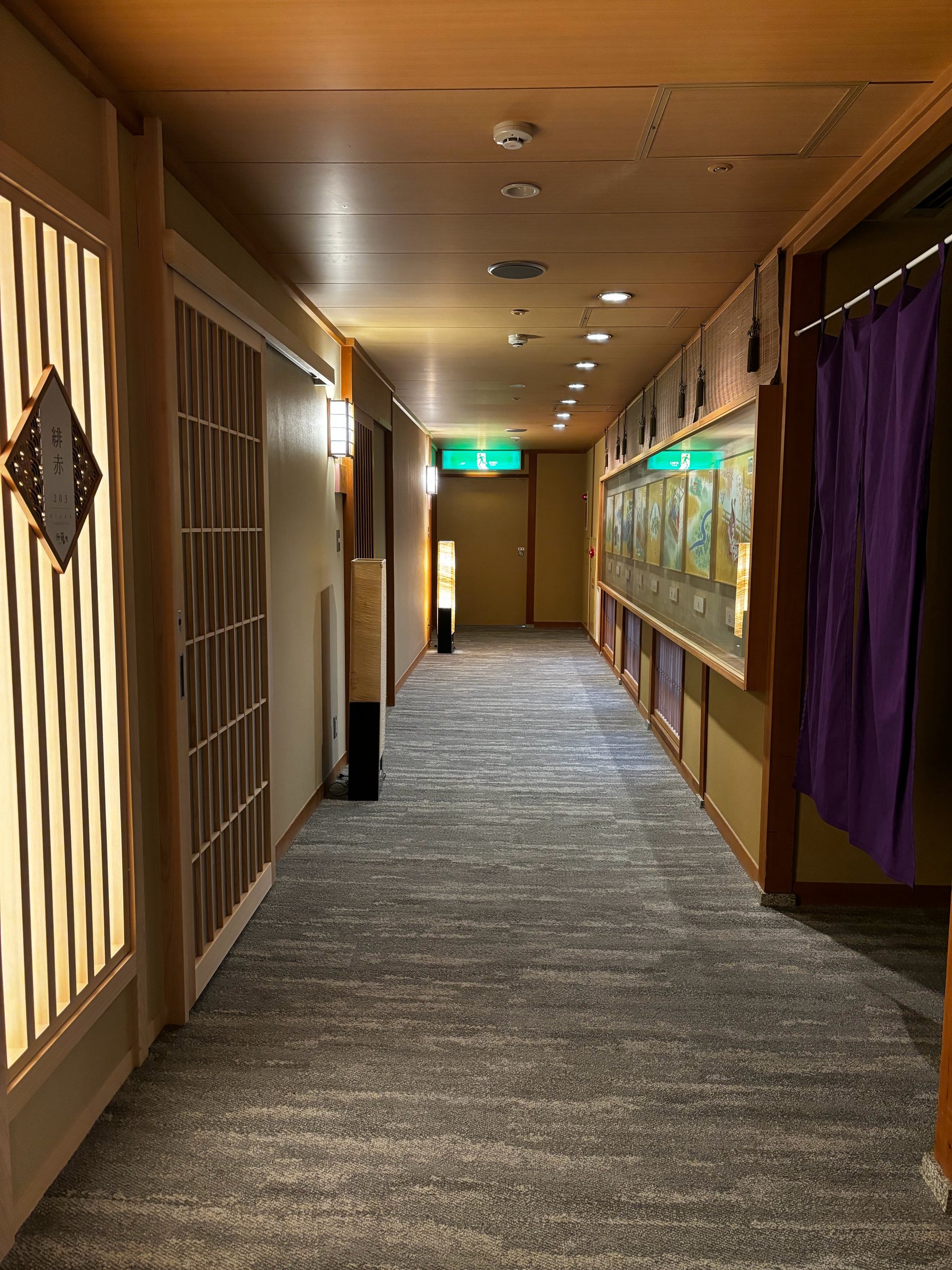
Along the left of the corridor runs a row of quiet room entrances framed in latticework, with a modern yet refined carpet underfoot. On the other side hangs a neatly ordered series of paintings on themes from The Tale of Genji. Together with the soft indirect lighting leading deeper into the building, they turn what is merely a passageway into something like the gallery of an art museum.
The gold-ground Genji paintings quietly assert the ryokan’s cultivated sense of beauty. Each is labeled with the name of its chapter, such as “Hana no En” (The Festival of the Cherry Blossoms) or “Sakaki” (The Sacred Tree), and each is carefully protected behind glass and lit so that its delicate colors come forward.
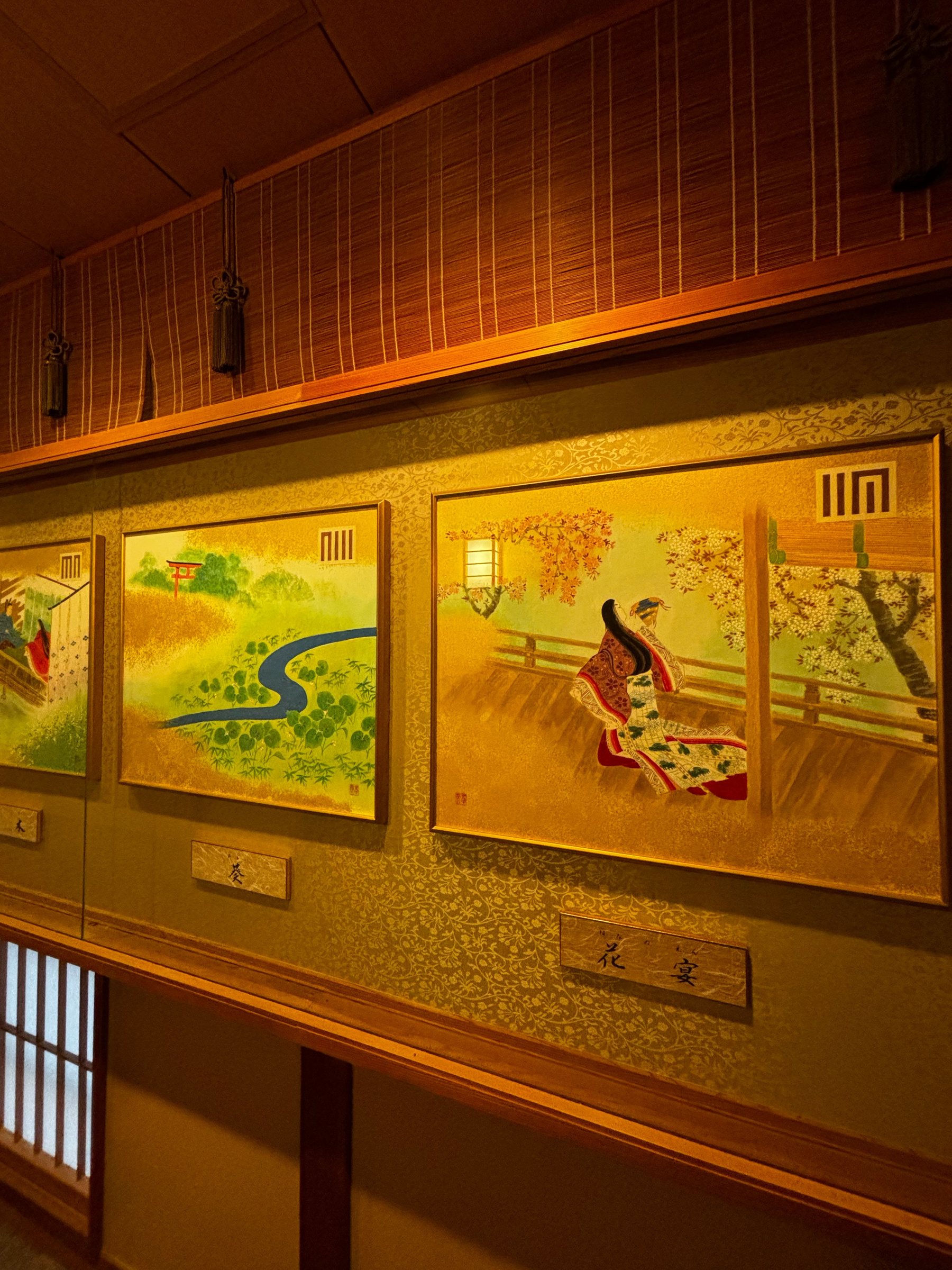
These are not mere decorations. By weaving classical Japanese literature into the design of the building, the ryokan lends the whole space an elegant tension, and we thought highly of that.
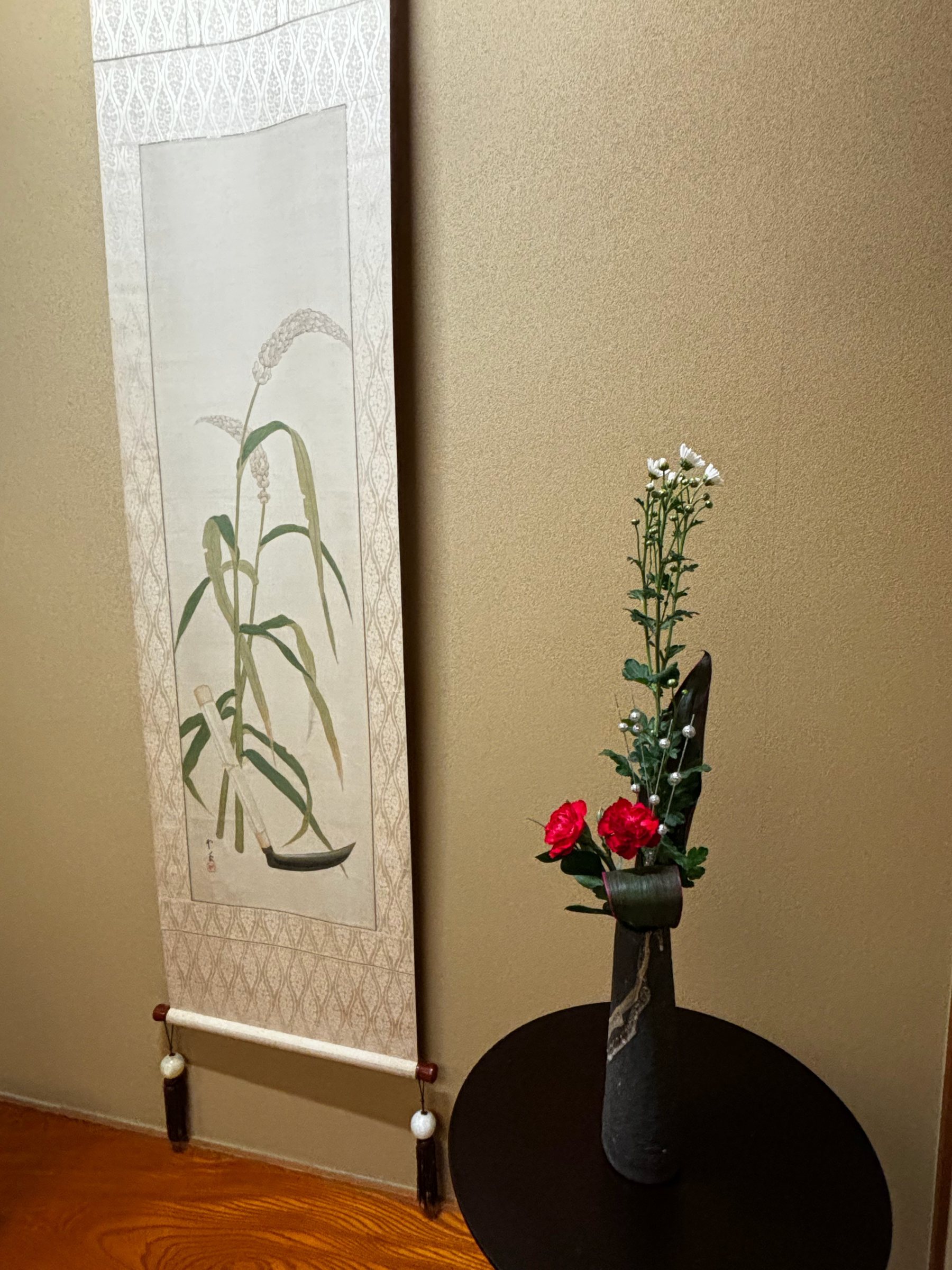
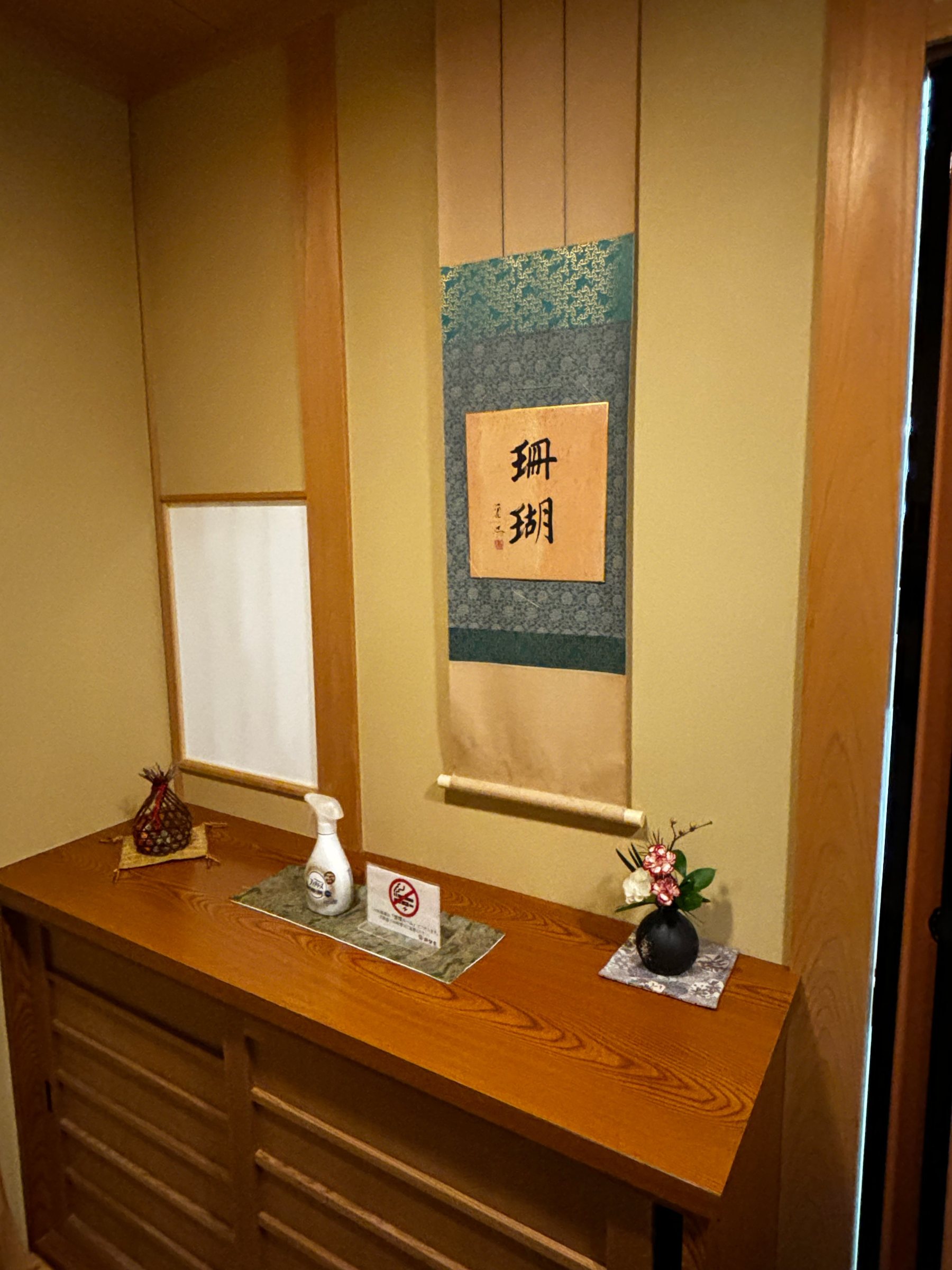
In front of a hanging scroll painted with plants stood a crisp flower arrangement: red and white blooms and small white chrysanthemums in a deep vessel, with the curve of the leaves pulling the composition together. It was faithful to the fundamentals of kadō yet sophisticated enough to sit comfortably in a modern space. This one corner made it clear that it had been prepared with real care for the guests who would pass by.
A torii in the lobby
The most symbolic flourish in the ryokan’s staging is the wooden torii that presides over the lobby.
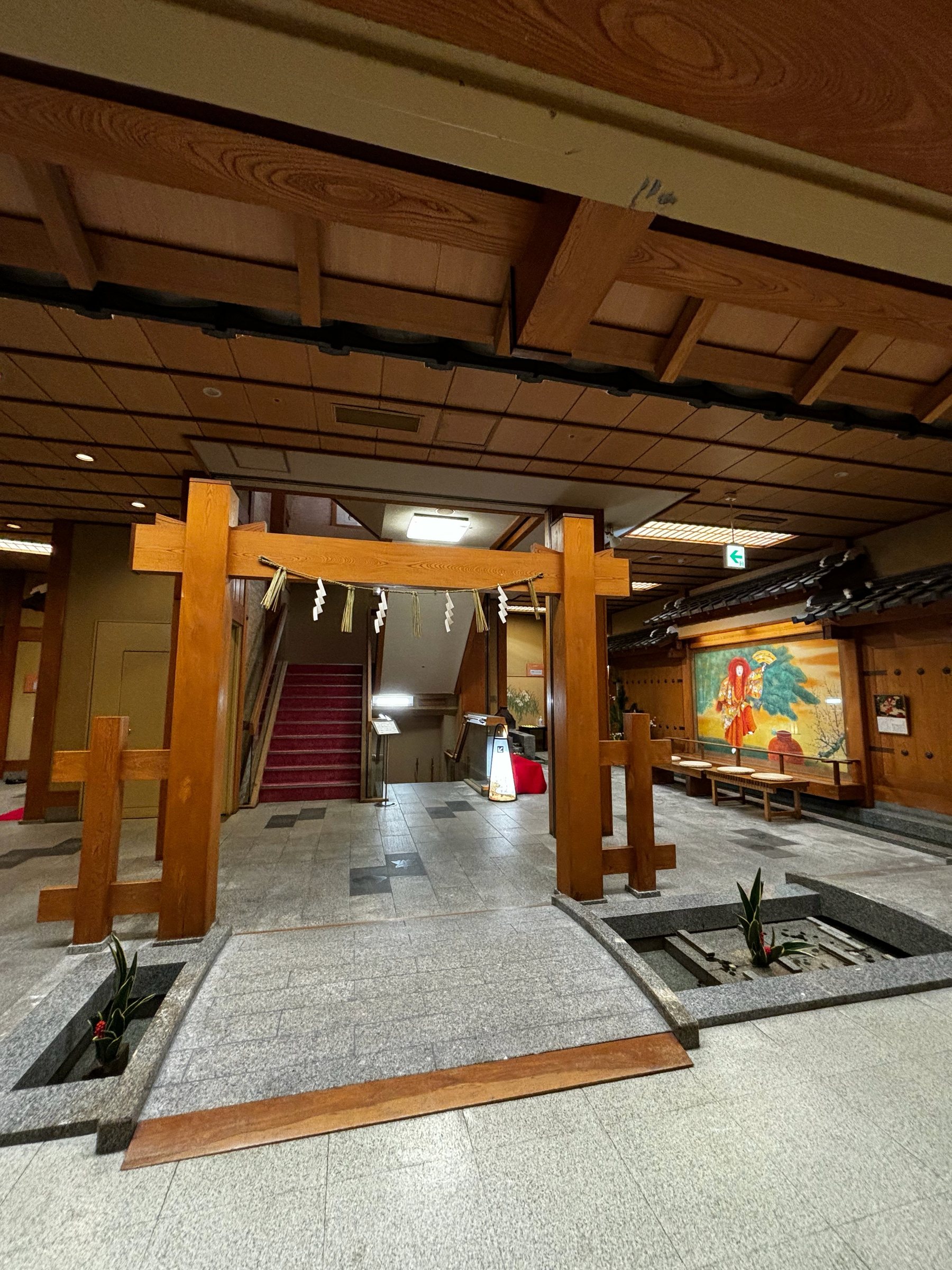
Placing a torii and a shimenawa, the sacred straw rope, indoors makes a striking impression, an instant sense of stepping out of everyday life. A richly colored painting behind it, reminiscent of Noh, and a flowing water feature in front work together to evoke a town where the gods reside, and the effect is solemn.
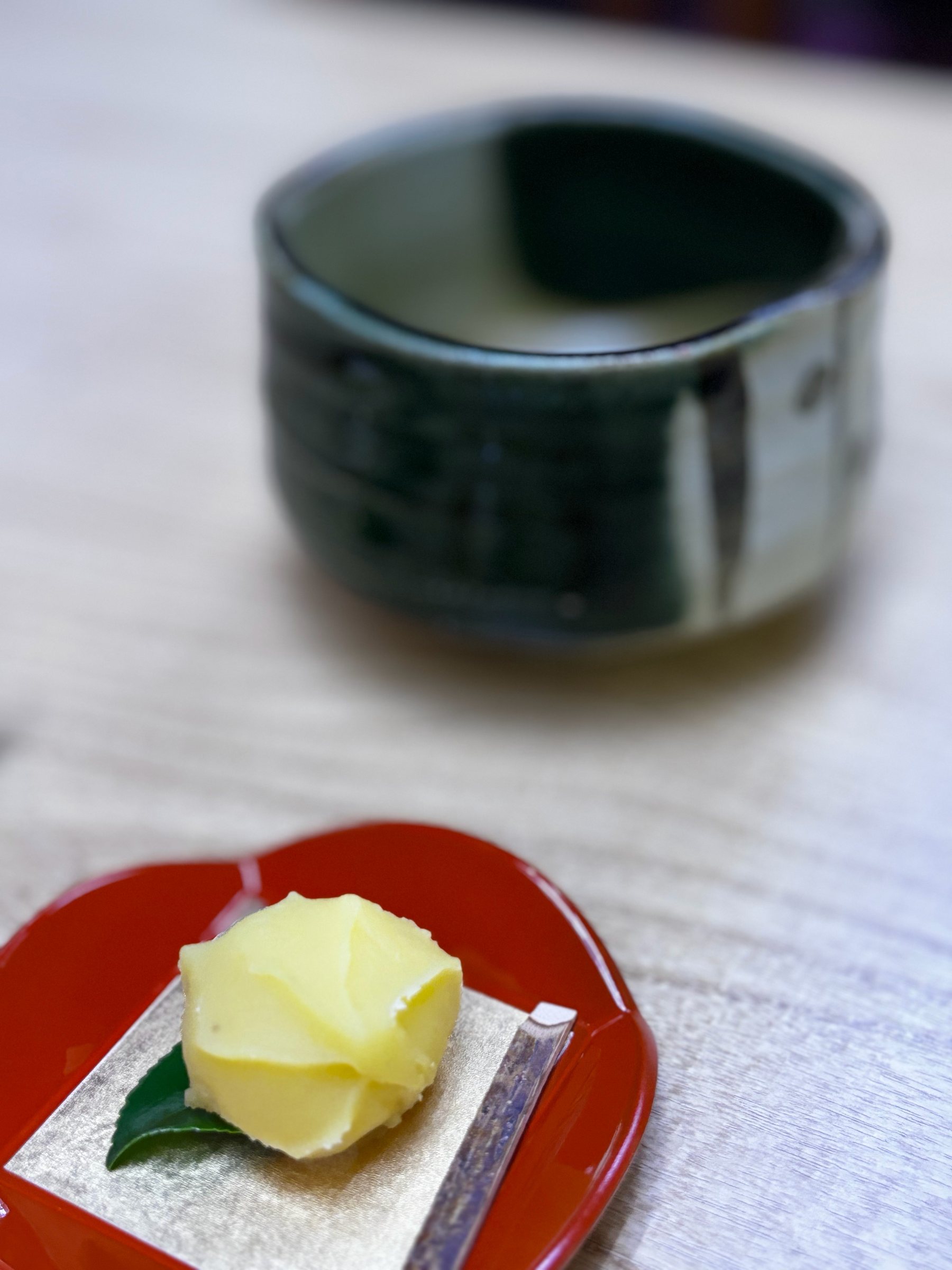
In keeping with the importance Asanoya places on the way of tea, guests are welcomed with carefully whisked matcha and a sweet. It is a refined way of letting us experience ichigo ichie through all the senses, and it relies on no grand gestures, simply expressing the spirit of a host preparing tea for a single guest.
The room, and a bath of our own
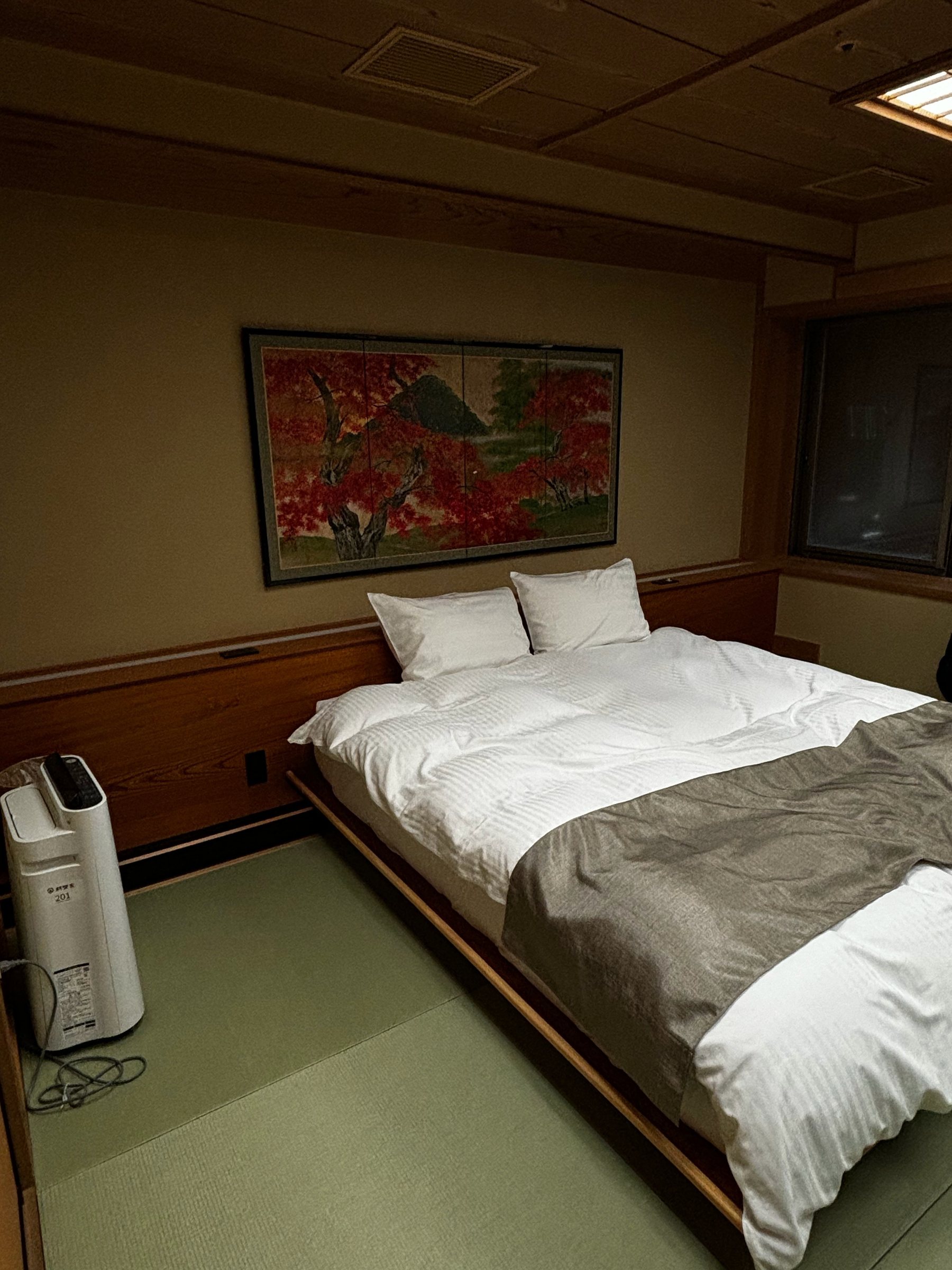
Behind the beds, a magnificent painting of autumn maples, either a folding screen or a large framed work, brings a striking splendor and sense of luxury to the whole room. Using a traditional artwork in place of a headboard is a clever idea, and it turns the bedroom, the most private of spaces, into something special.
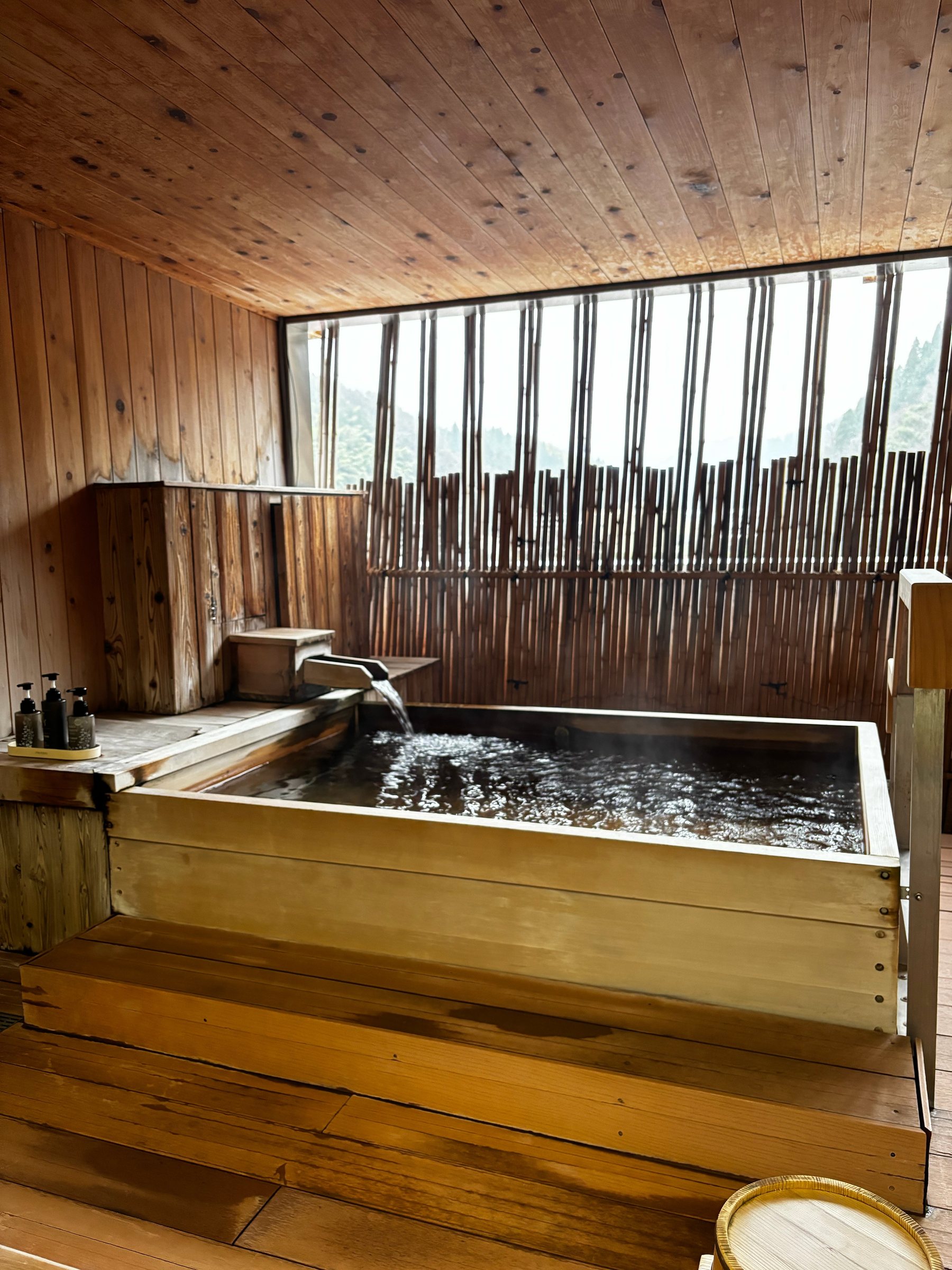
Then the room’s private open-air bath comes into view. The tub, made entirely of wood, is filled to the brim, and its surface catches the light from outside. A bamboo fence screens it from view, so we could feel the fresh air of Yumura’s natural surroundings on our skin and spend blissful time without being disturbed by anyone.
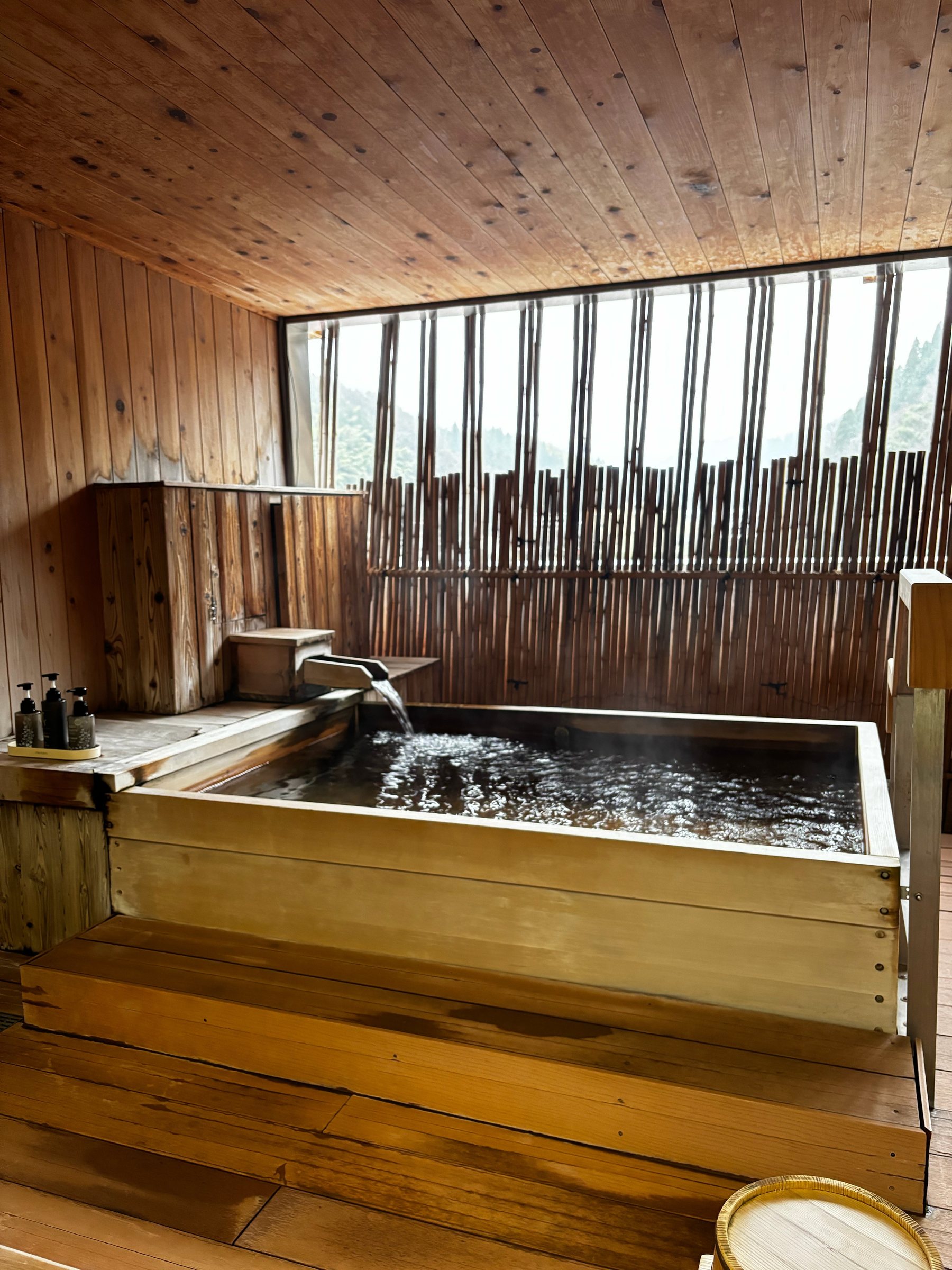
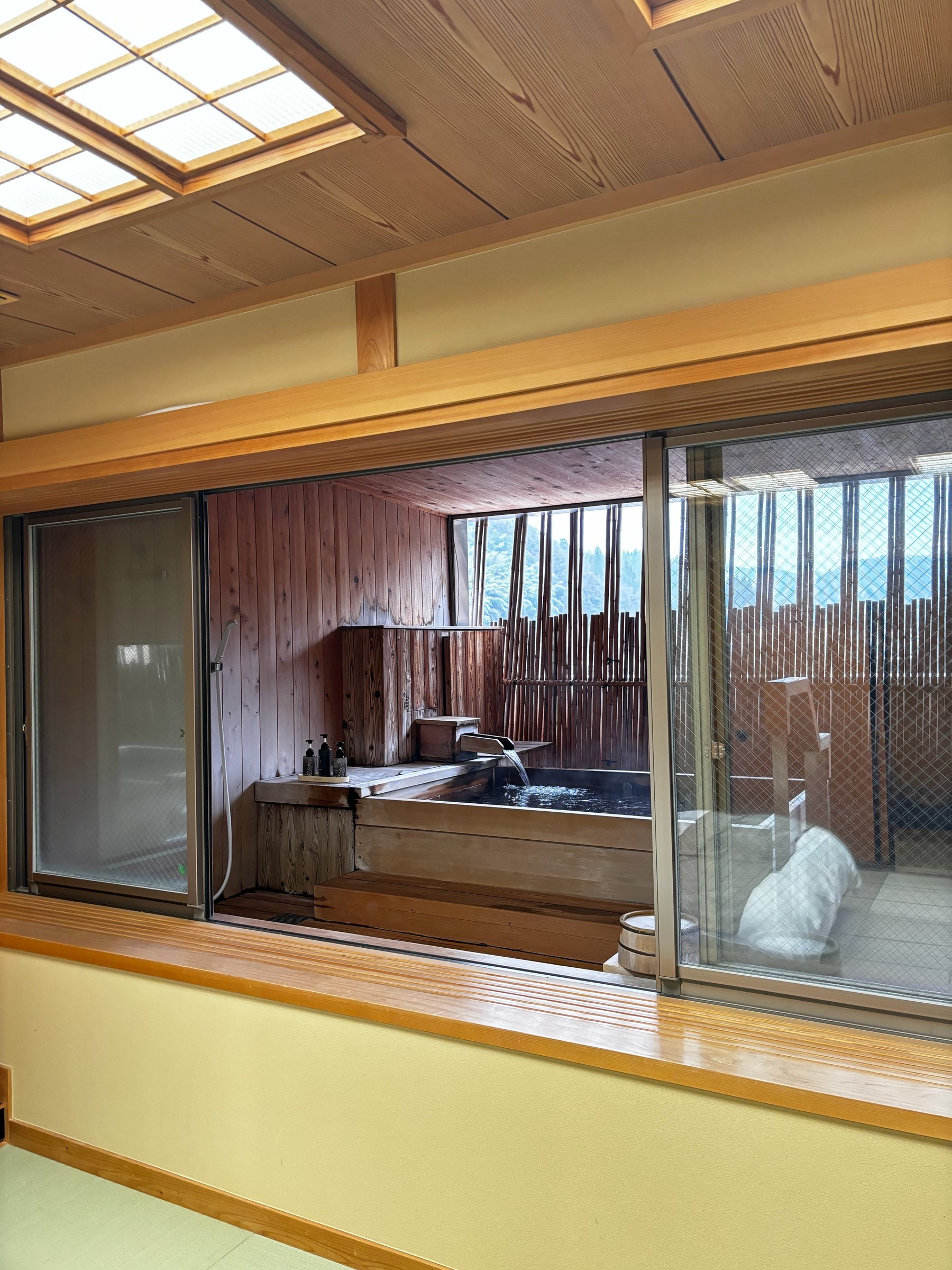
The bath is visible through glass from the main room, a design that creates a sense of openness. After bathing we could step straight into the tatami room to cool down, and the layout flows easily. It distils the practical beauty of a hot spring ryokan.
The large baths
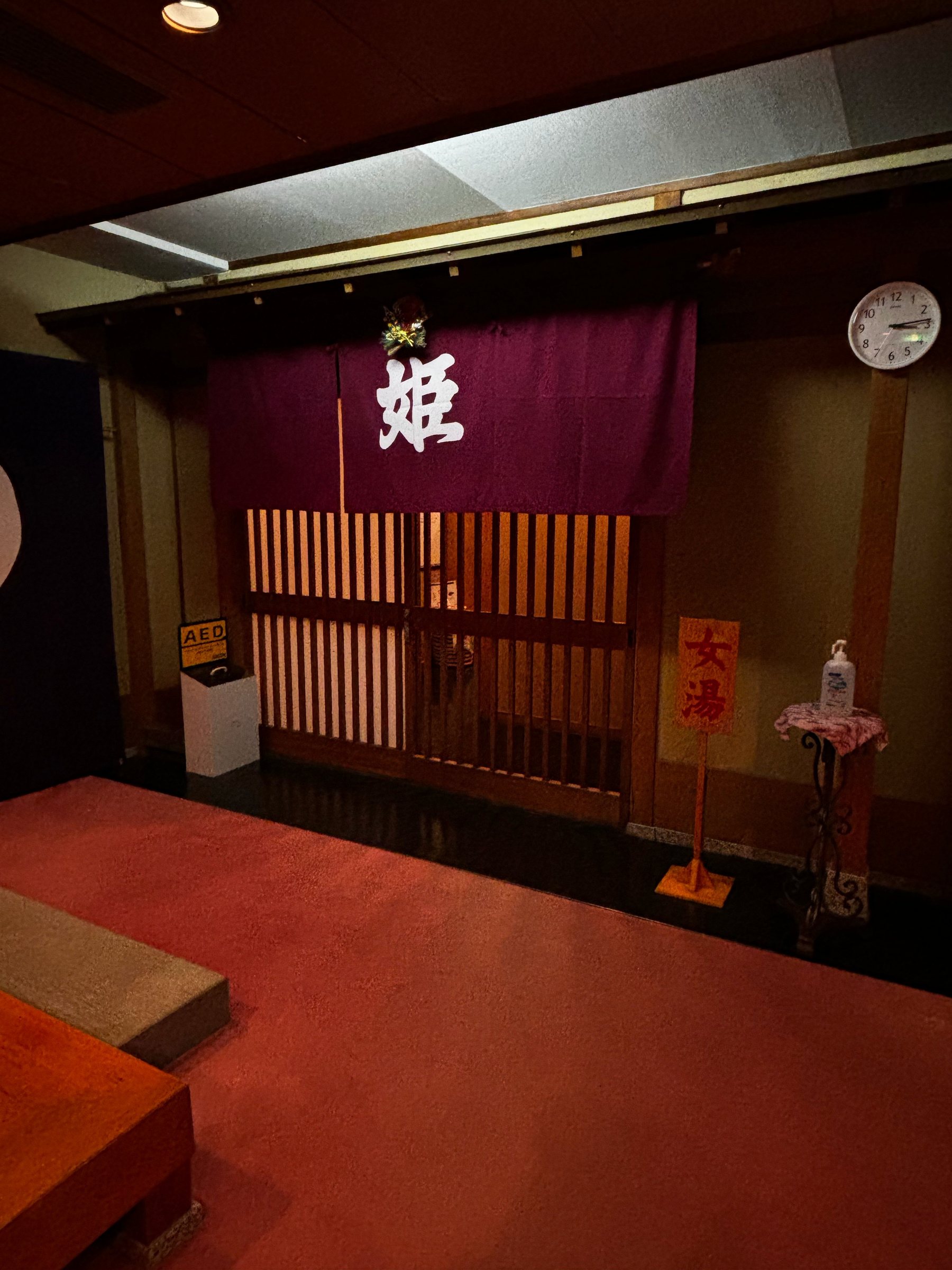
Next, we went to the large communal baths.
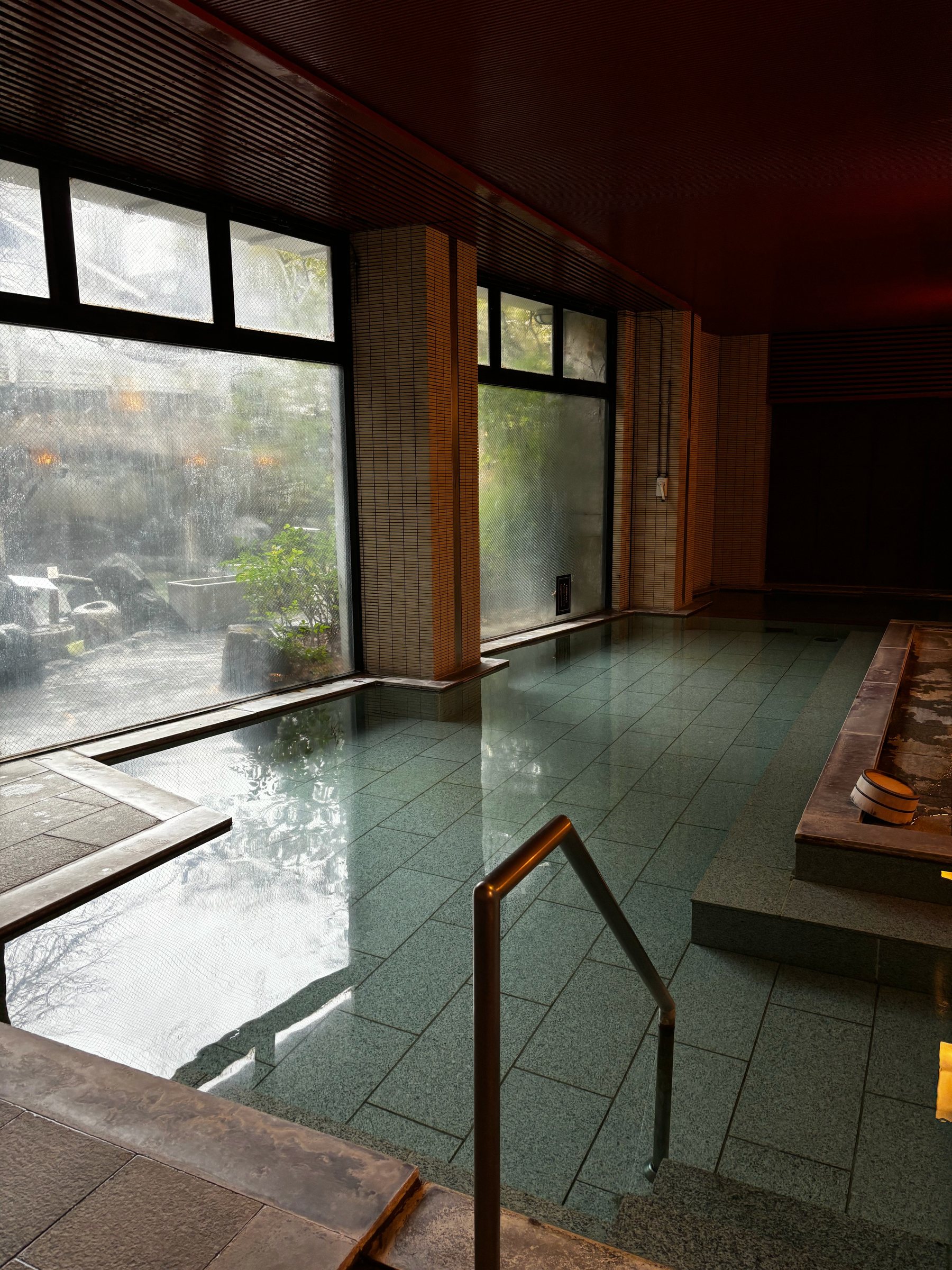
The floors and tubs are clad in clean-looking stone, and the baths are filled to the brim with Yumura’s plentiful hot spring water.
What stands out is the large windows overlooking the garden outside. Natural light falls through the glass and glints on the water, giving the whole bathhouse a pleasant sense of space. Handrails and carefully designed steps allow guests of all ages to bathe safely, a solid foundation for an unhurried, relaxing soak.
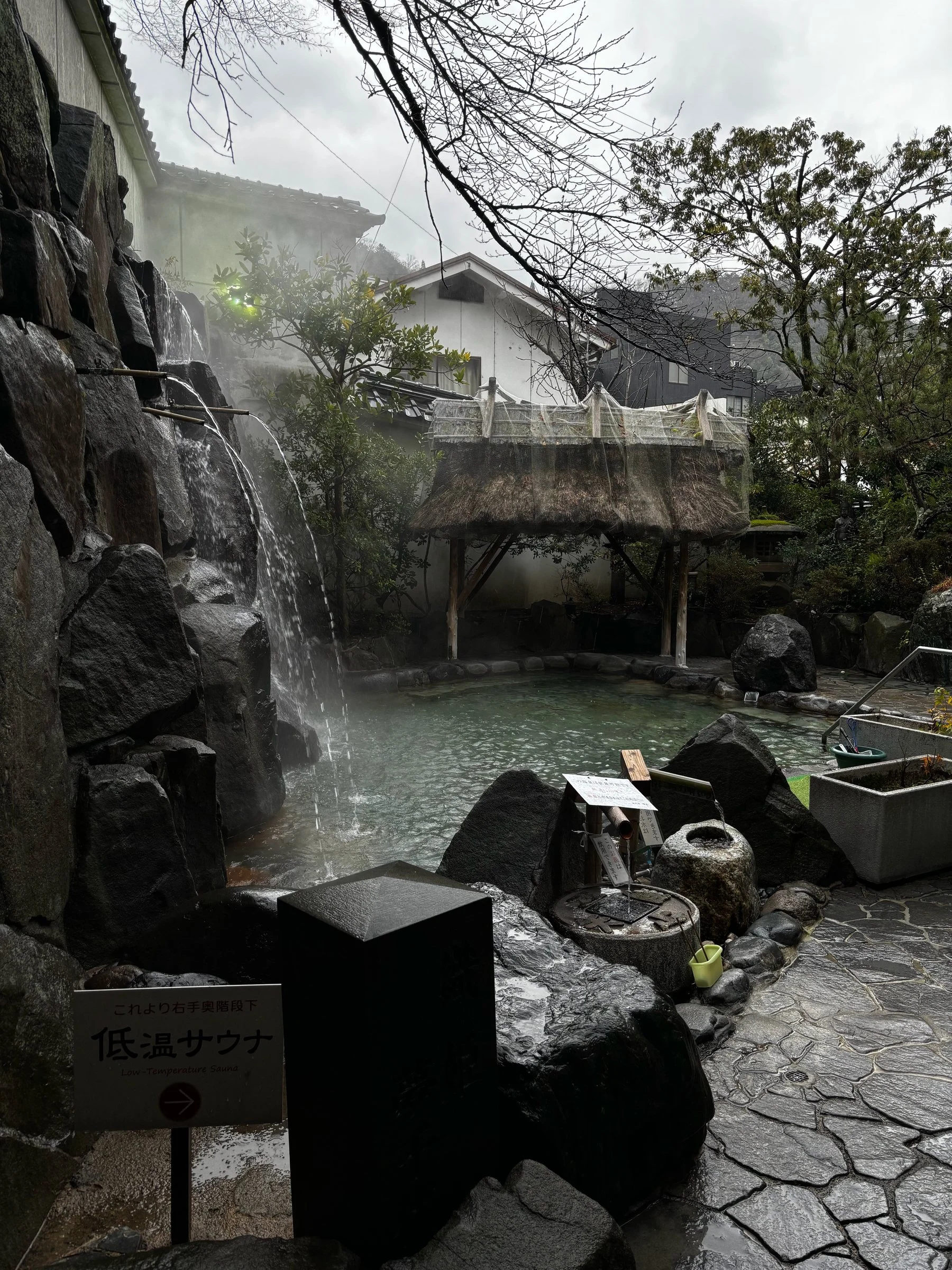
The outdoor bath beyond the indoor one is the high point of bathing at Asanoya. A bold waterfall tumbling down the rock face and a tub ringed with rough boulders bring the power of nature very close. At the back, a thatched-roof arbour adds the simple, deep charm of a San’in hot spring town. In front, a drinking fountain carries a sign saying “This water is drinkable”, a fine way of letting guests experience the quality of the spring directly. With the greenery of the trees beyond the steam, it is a bath to be enjoyed with all five senses.
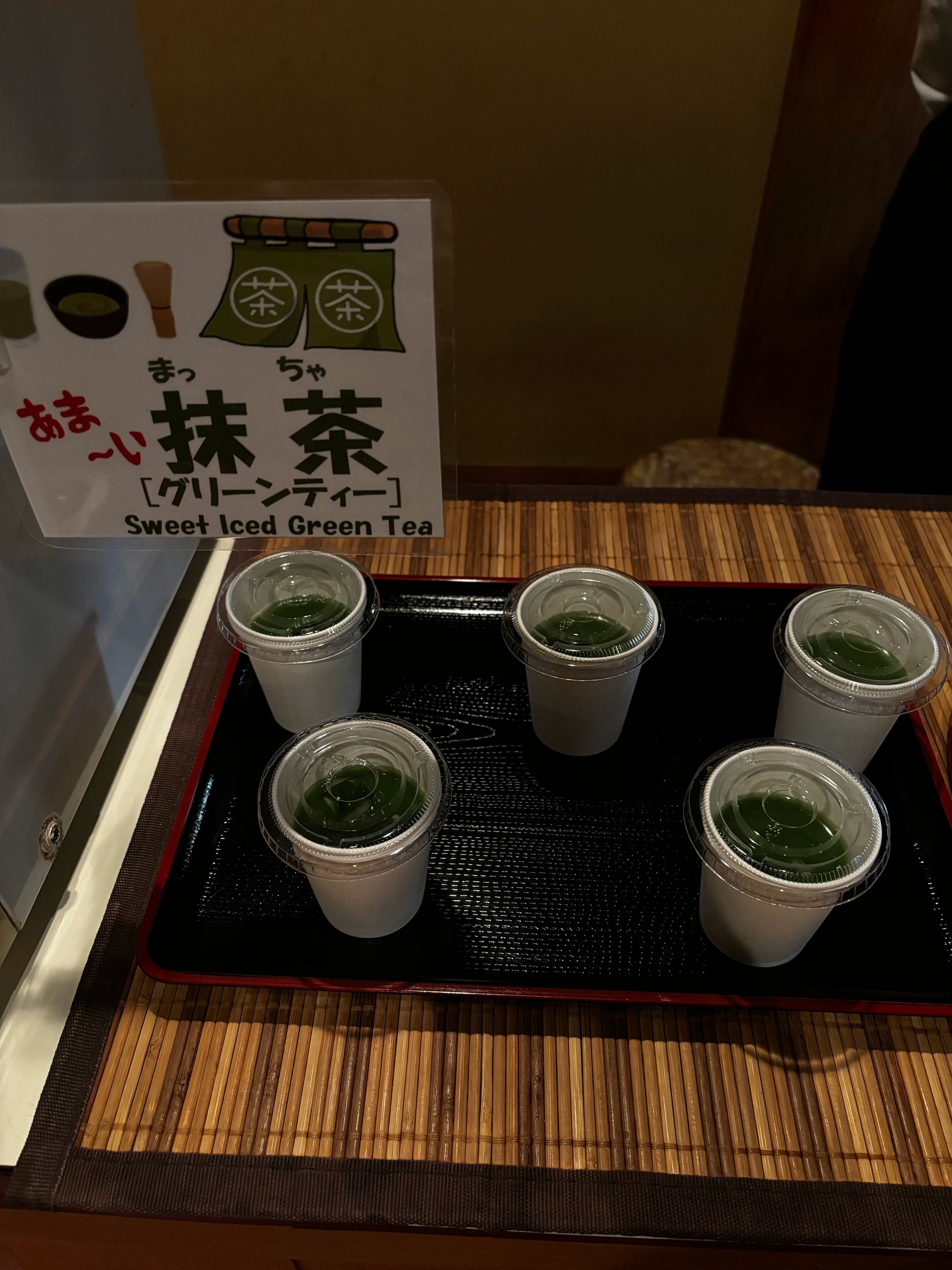
After the bath, cold green tea was set out in small lidded clear cups, ideal for cooling a body flushed from the hot water. It was another charming touch inspired by the ryokan’s devotion to the way of tea and its wish to please its guests, however slightly.
A New Year’s Eve dinner
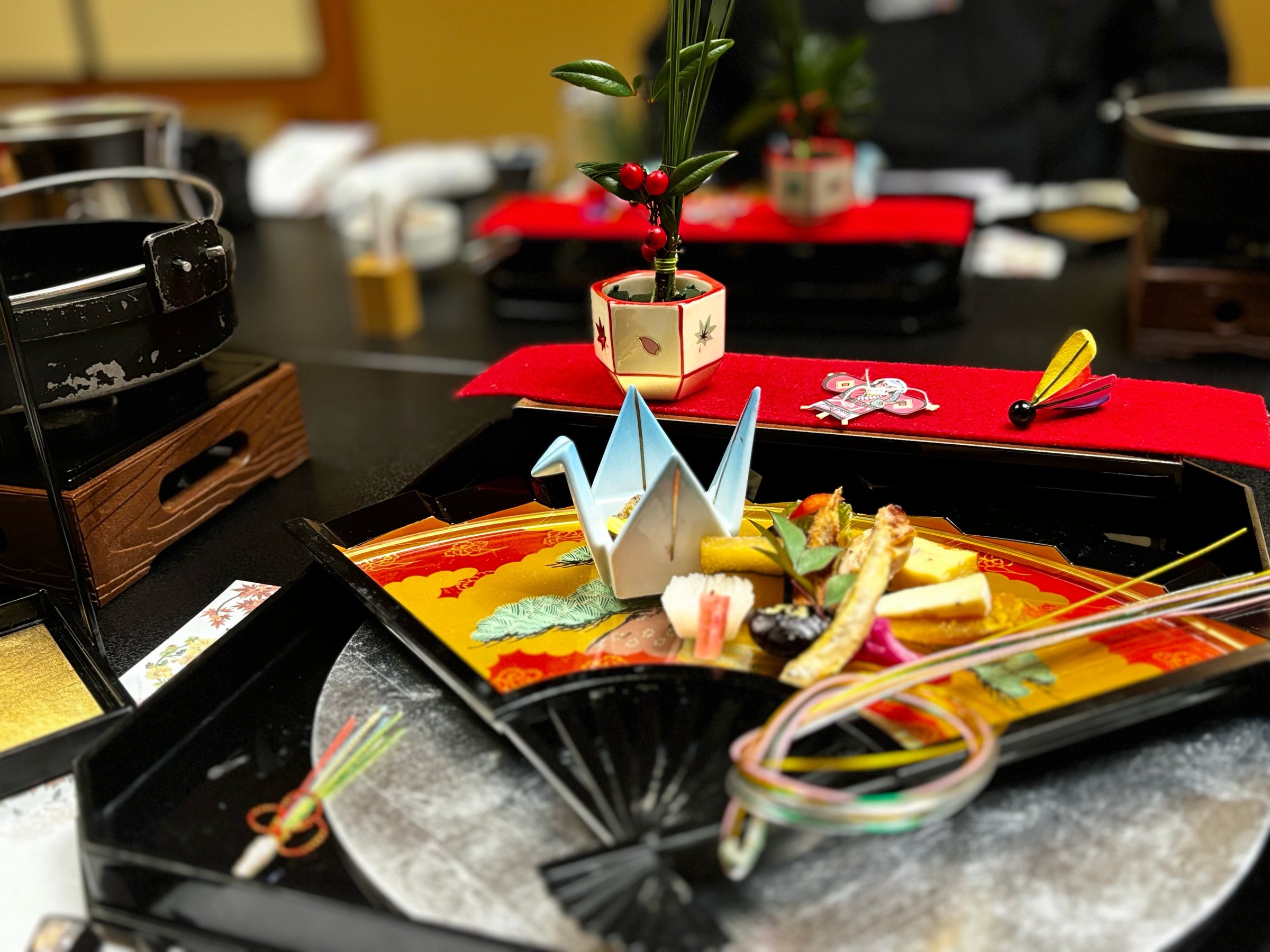
The balance of colors on the table was carefully calculated. Miniature hagoita battledores and shuttlecocks, both reminders of the New Year, decorated the table, along with a small flower arrangement. Yes: because we had come at the very end of the year, dinner was a special New Year edition. The dishes came in a wide variety of shapes, fan-shaped, square and round, building our anticipation for the meal to come.
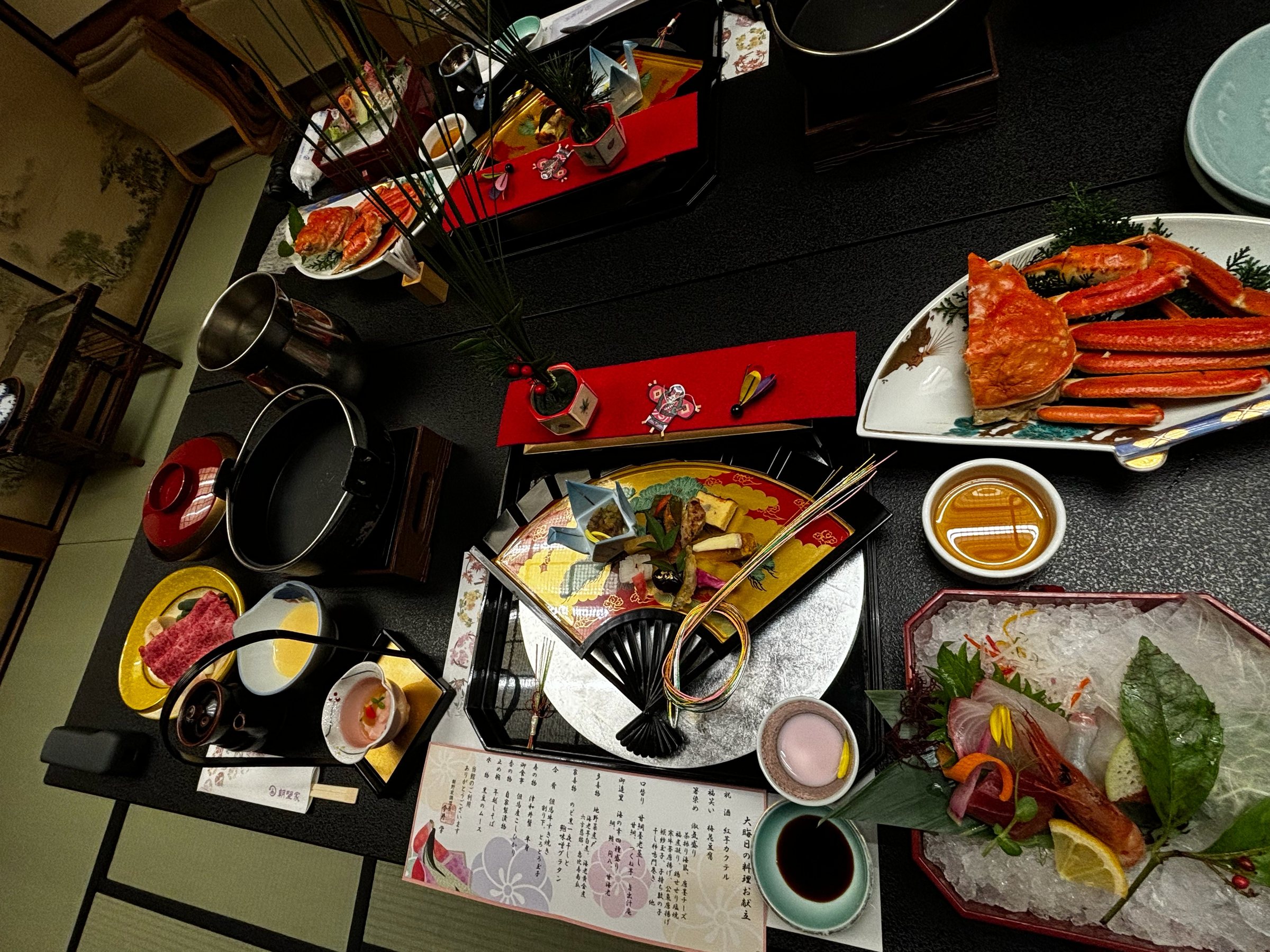
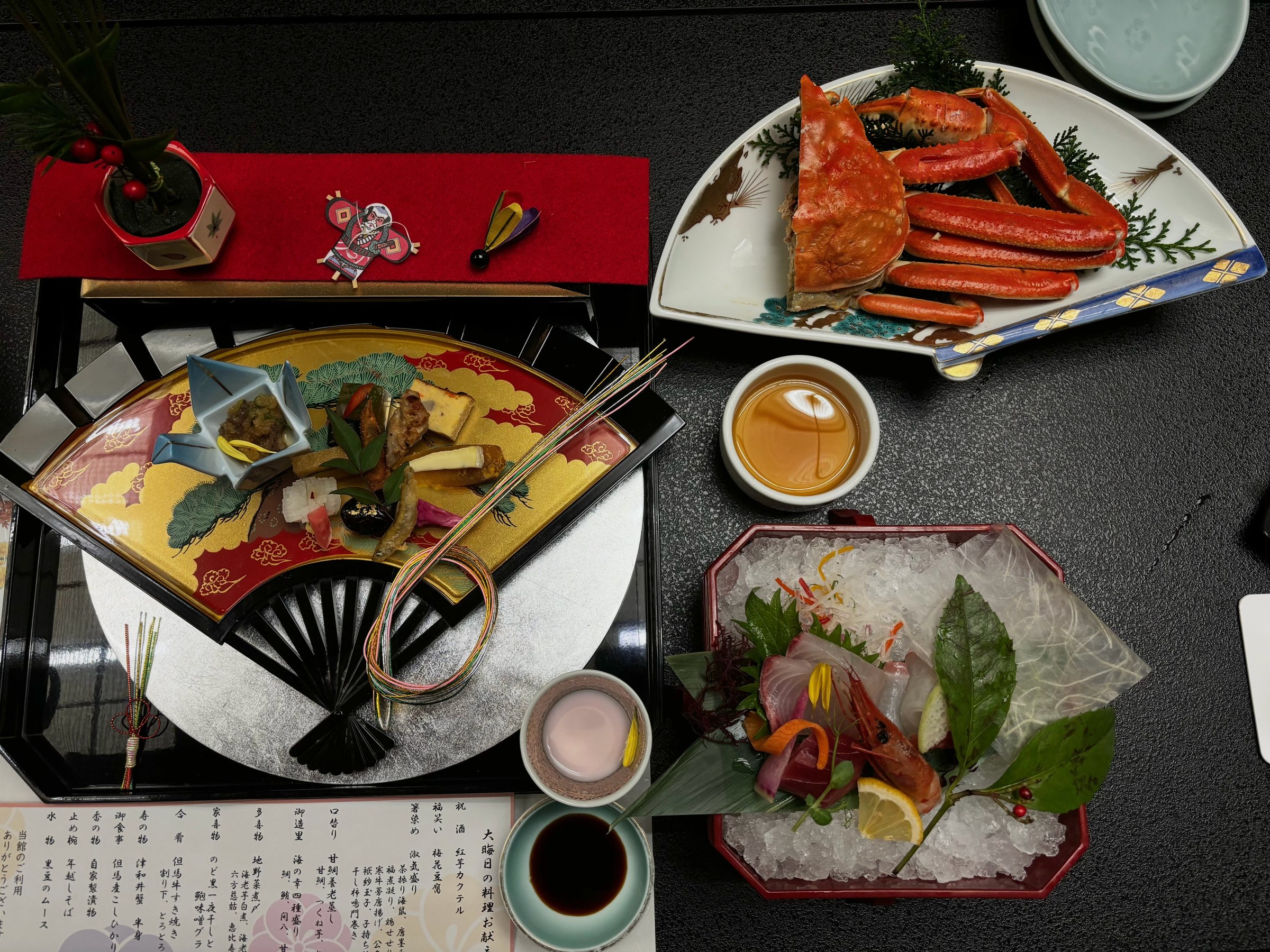
The undisputed star of a San’in winter and spring is matsuba-gani, snow crab. It arrived on a beautiful fan-shaped painted plate, served boldly in the shell yet scored for easy eating. A bed of green pine needles set off its red, presenting the ingredient in all its regal dignity without fuss.
The sashimi platter was laid on crushed ice: sweet shrimp (or perhaps tosaka-ebi) and local fish, sharply cut and beautifully arranged. The yellow of lemon and chrysanthemum petals stood out. It was a straightforward way of carrying the freshness of the fish directly to the palate.
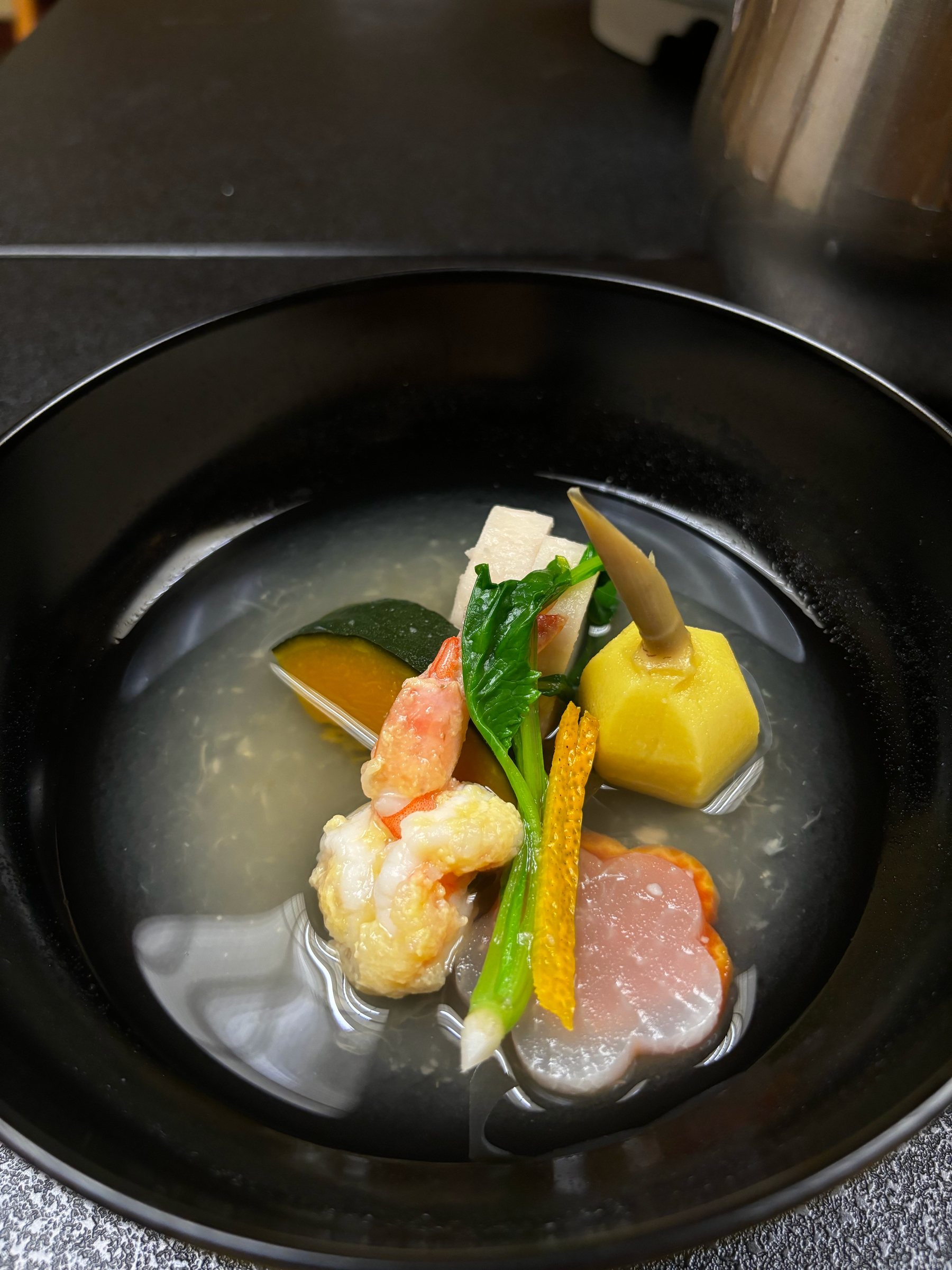
The clear soup served midway through the meal came in a beautiful black lacquer bowl that recalled Wajima ware, and it was very accomplished. In an elegant, transparent dashi sat prawn, kabocha squash and kuwai (arrowhead tuber), neatly peeled into a hexagonal tortoiseshell shape. Wheat gluten shaped like a plum blossom and a fragrant curl of yellow yuzu peel completed it. In that one bowl, the harmony of flower arrangement and tea that Asanoya values took complete form.
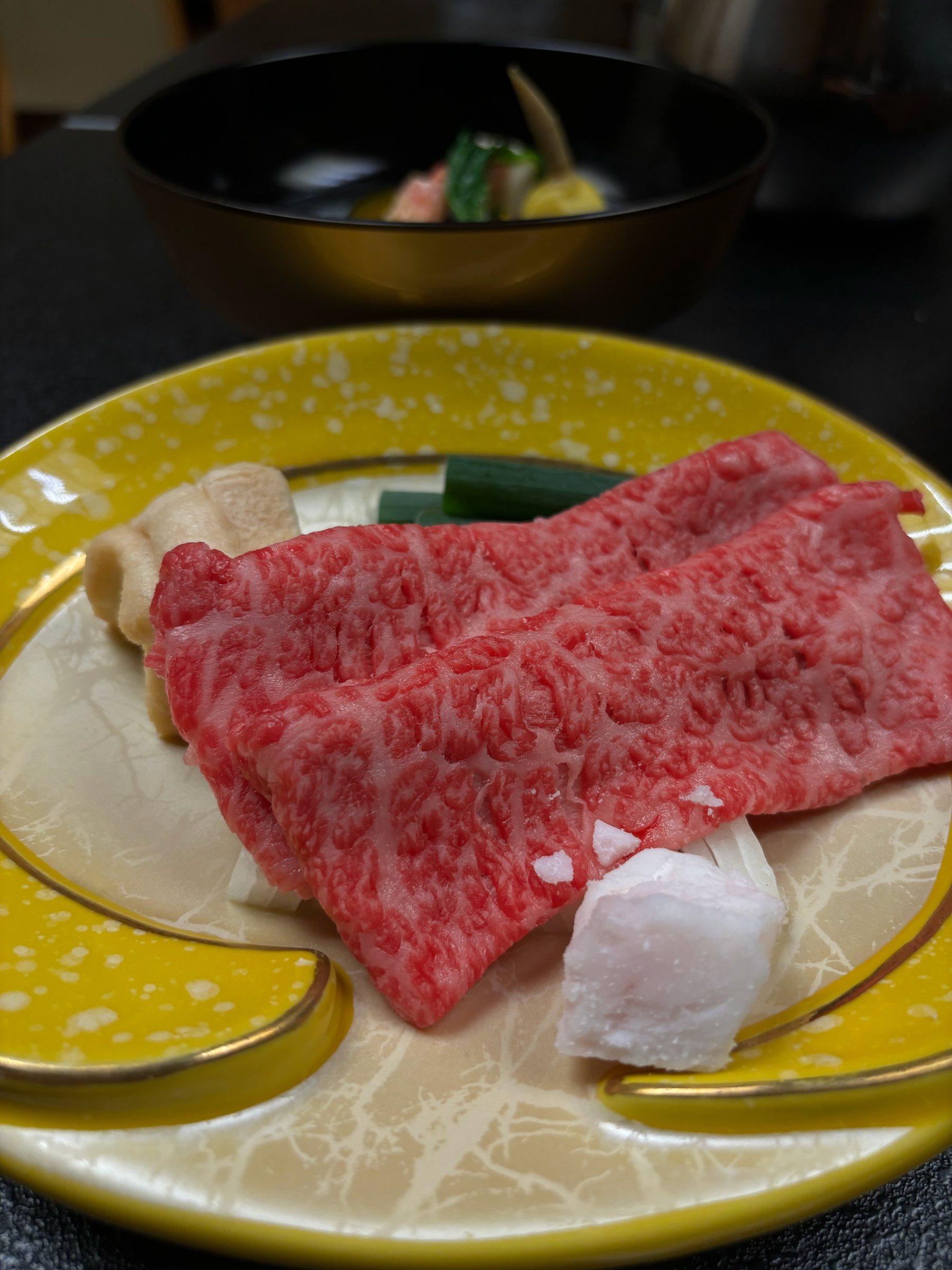
As the main meat course came beautifully marbled Tajima beef (or Kuroge Wagyu), presented on a bright yellow dish with a piece of beef fat in front for greasing the grill. We cooked it ourselves on individual burners, so each piece could be eaten exactly as we liked it, without losing any of the fine flavor of its fat.
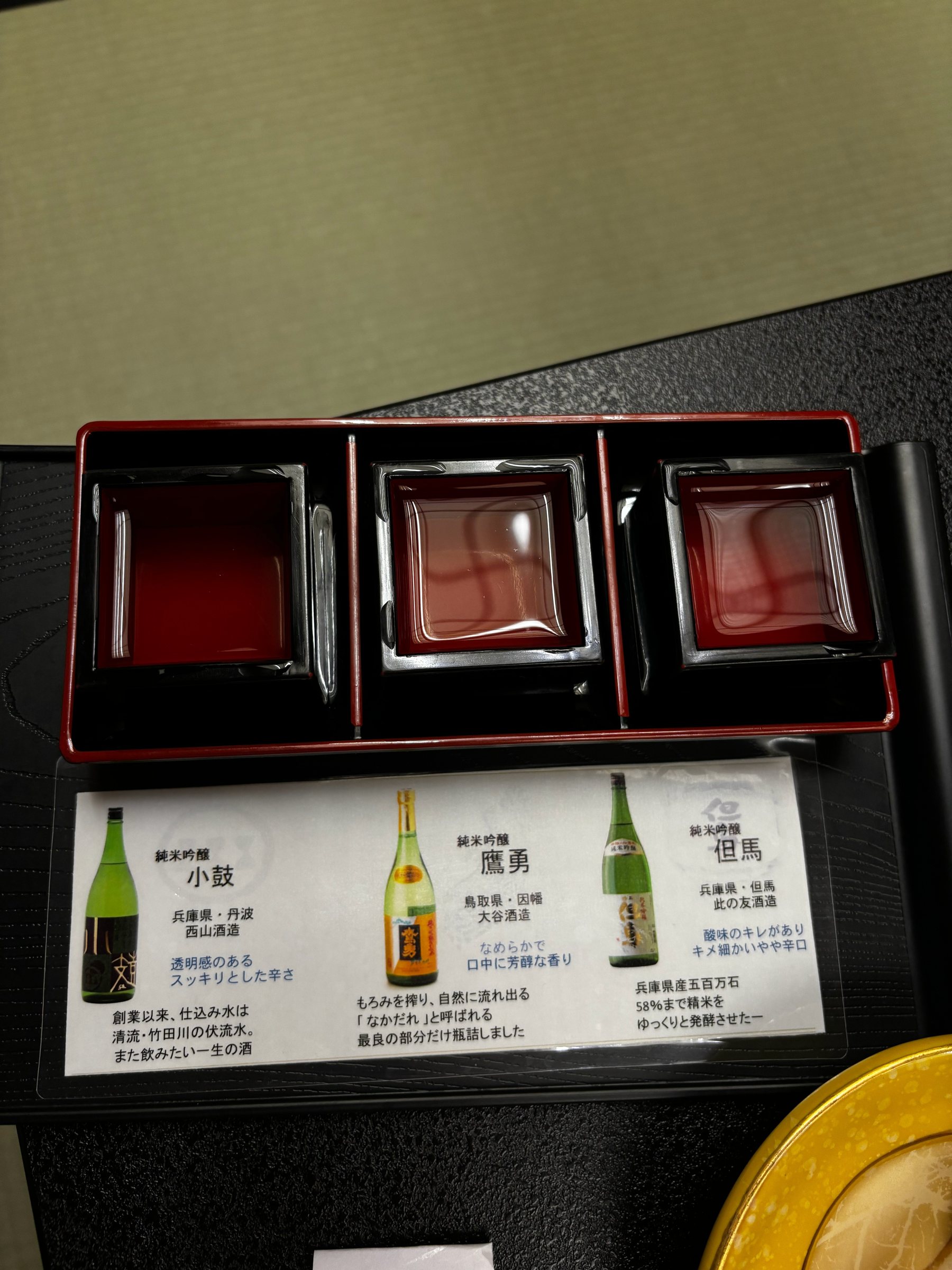
The sake selection felt very modern, taking in Takaisami from Tottori alongside Tajima and Kotsuzumi from Hyogo itself. Rather than stopping at the prefectural border, it let us taste one continuous sake culture across neighboring land, and it brought out the seafood of the San’in coast and the flavor of the Tajima beef all the better.
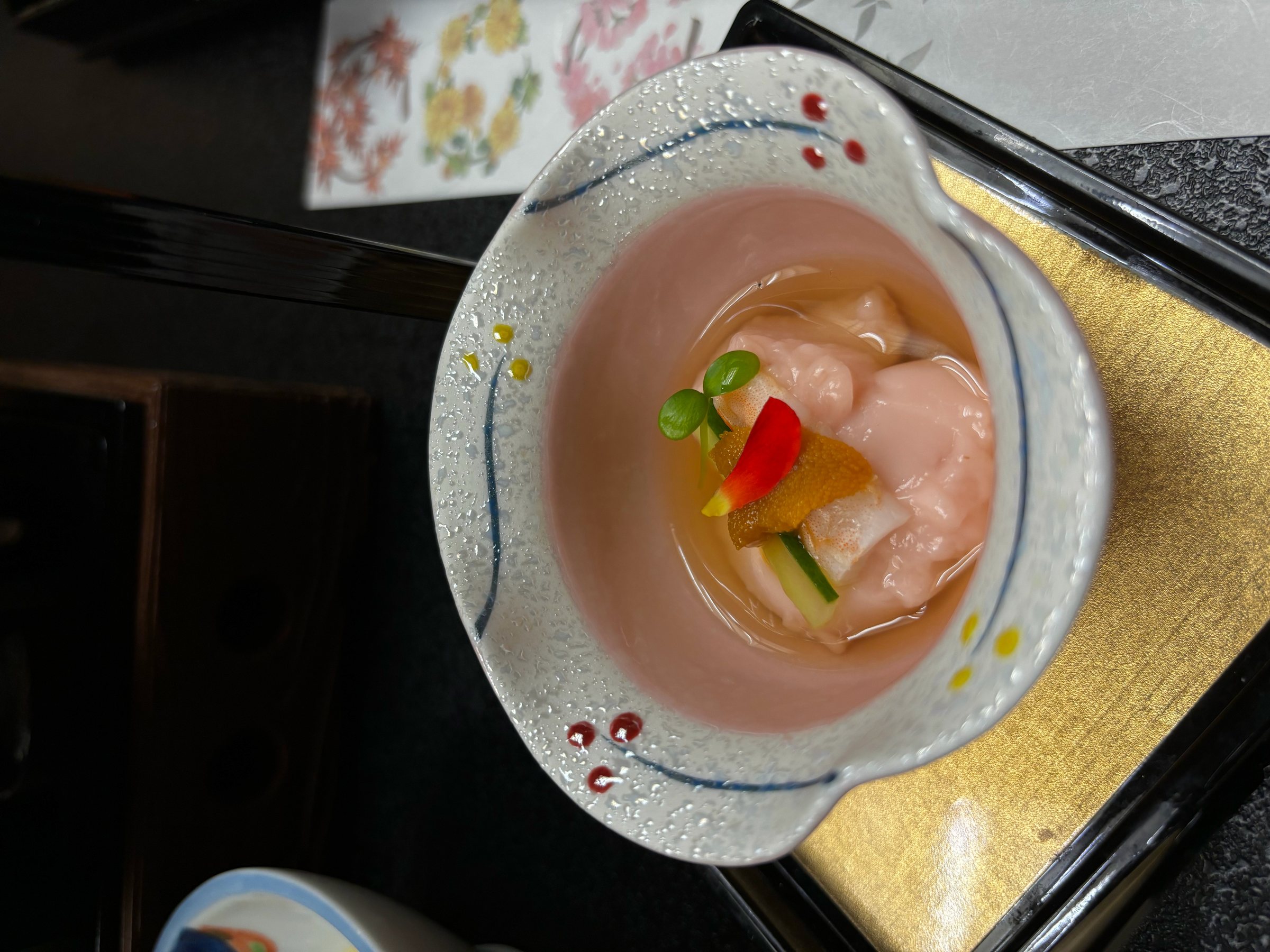
A small bowl in soft pink held a chilled dish of clams coated in a delicate dashi jelly, with sea urchin and sprouts for color.
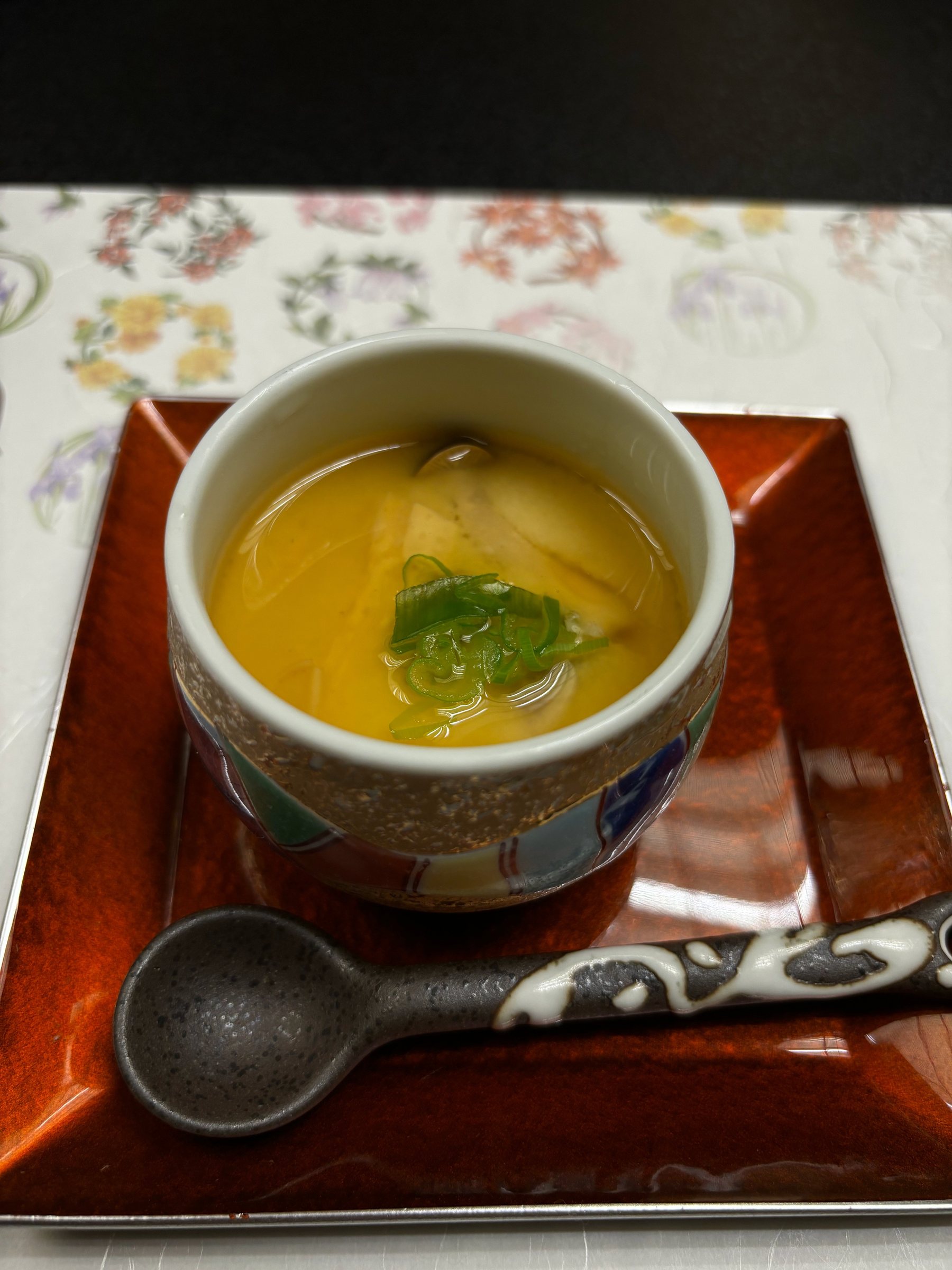
On a glossy brown lacquered tray sat a cup in a vivid Japanese pattern, with a textured ceramic spoon in front. The amber sauce covering the surface was beautifully glossy and sealed in the flavor of what lay beneath, while finely chopped green onion heaped in the center added a bright accent that pulled the whole dish together. The ryokan’s respect for the flavor of dashi showed here, too.
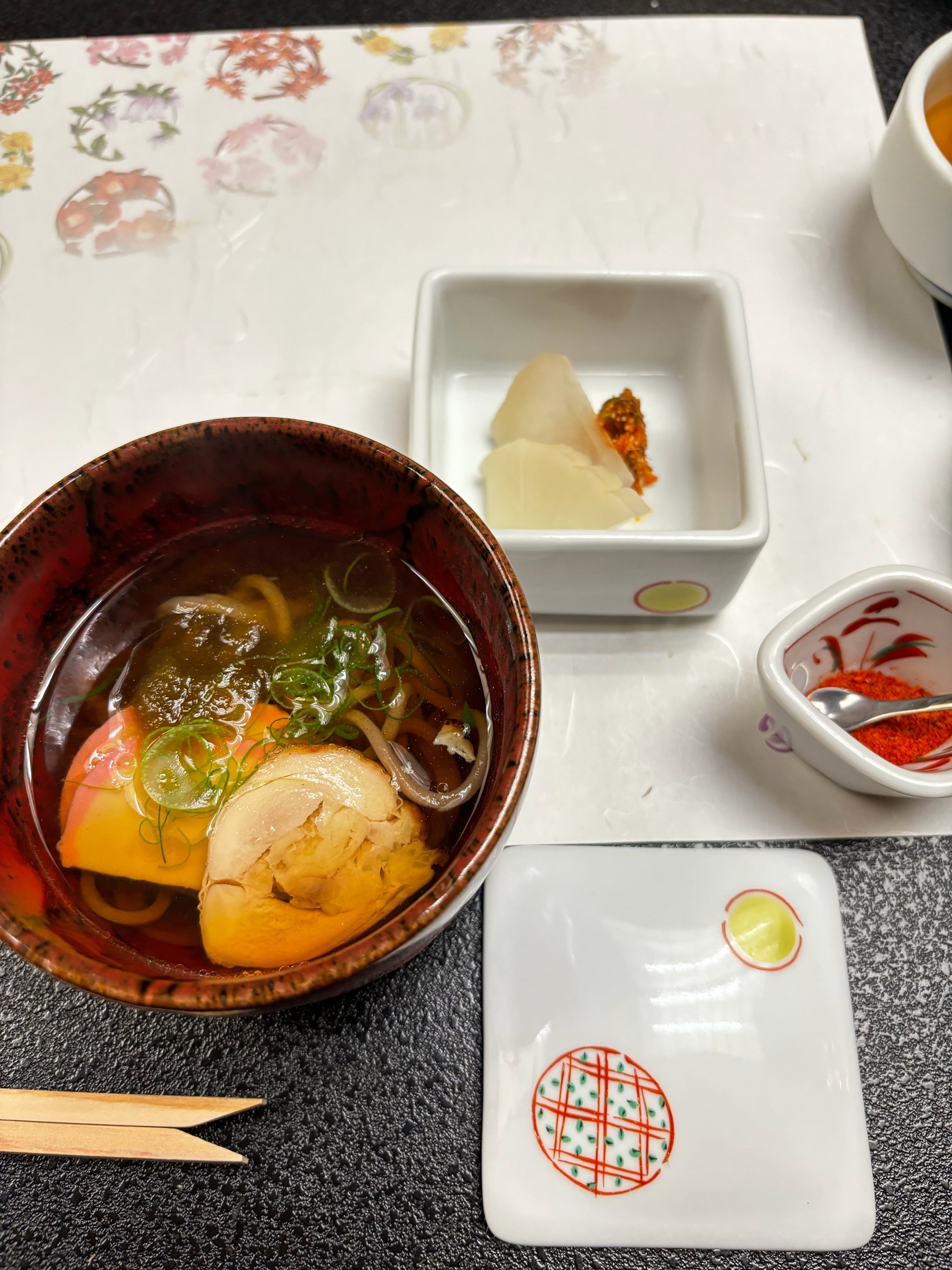
Next came warm soba: tender chicken, kamaboko fish cake, shaved oboro kombu and green onion in a clear broth. Beside it, on a fine white square plate, were pickles (daikon, with a miso condiment), and a little container of ground chilli was provided with a spoon so we could adjust the heat to taste. It was a well-judged close, sitting gently on stomachs that had been through an evening of bathing and eating.
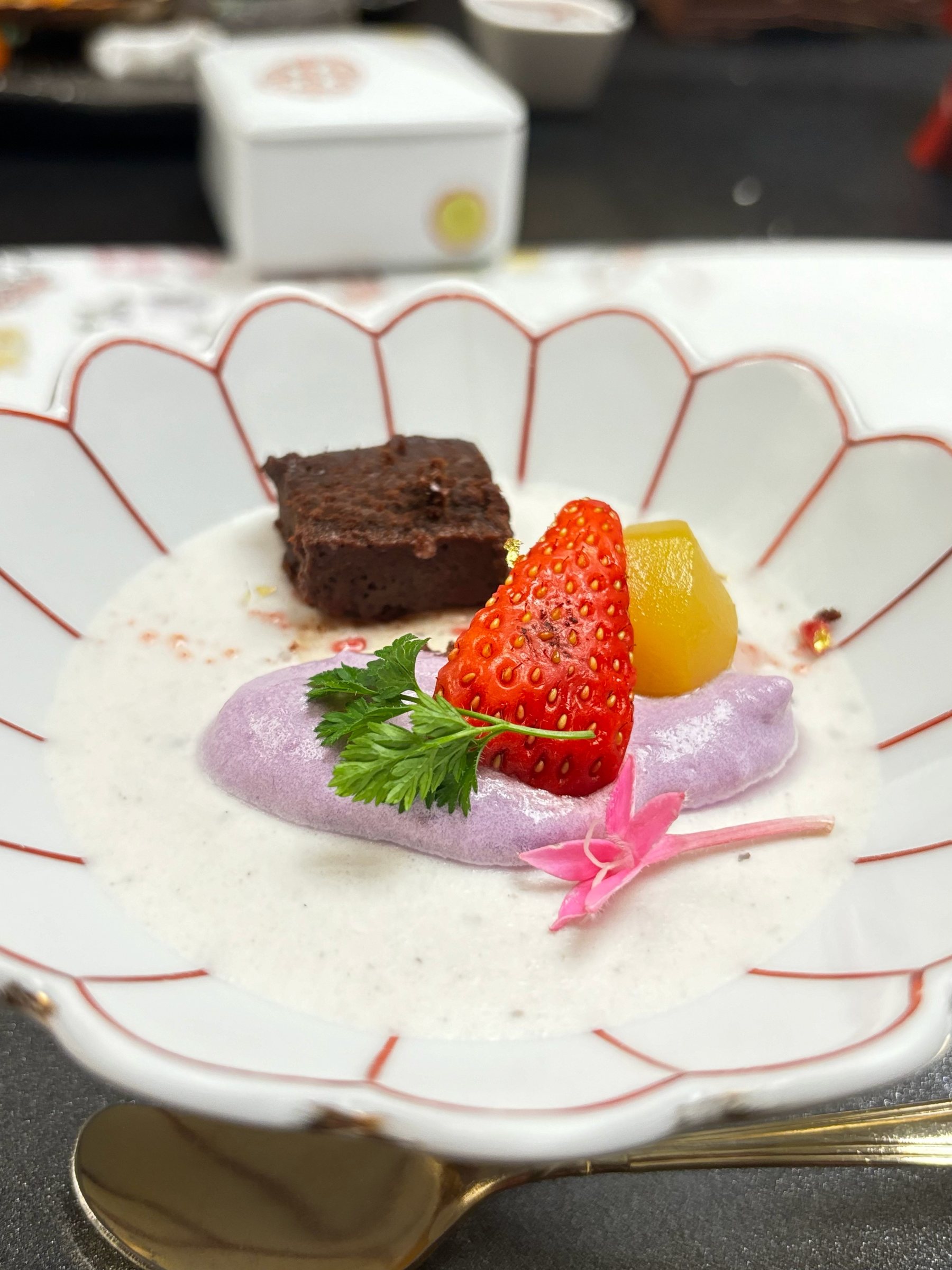
For dessert, a white mousse base was topped with a pale purple sweet potato sauce, then a juicy strawberry, a rich brownie and a candied chestnut, all nicely balanced.
Breakfast on New Year’s Day
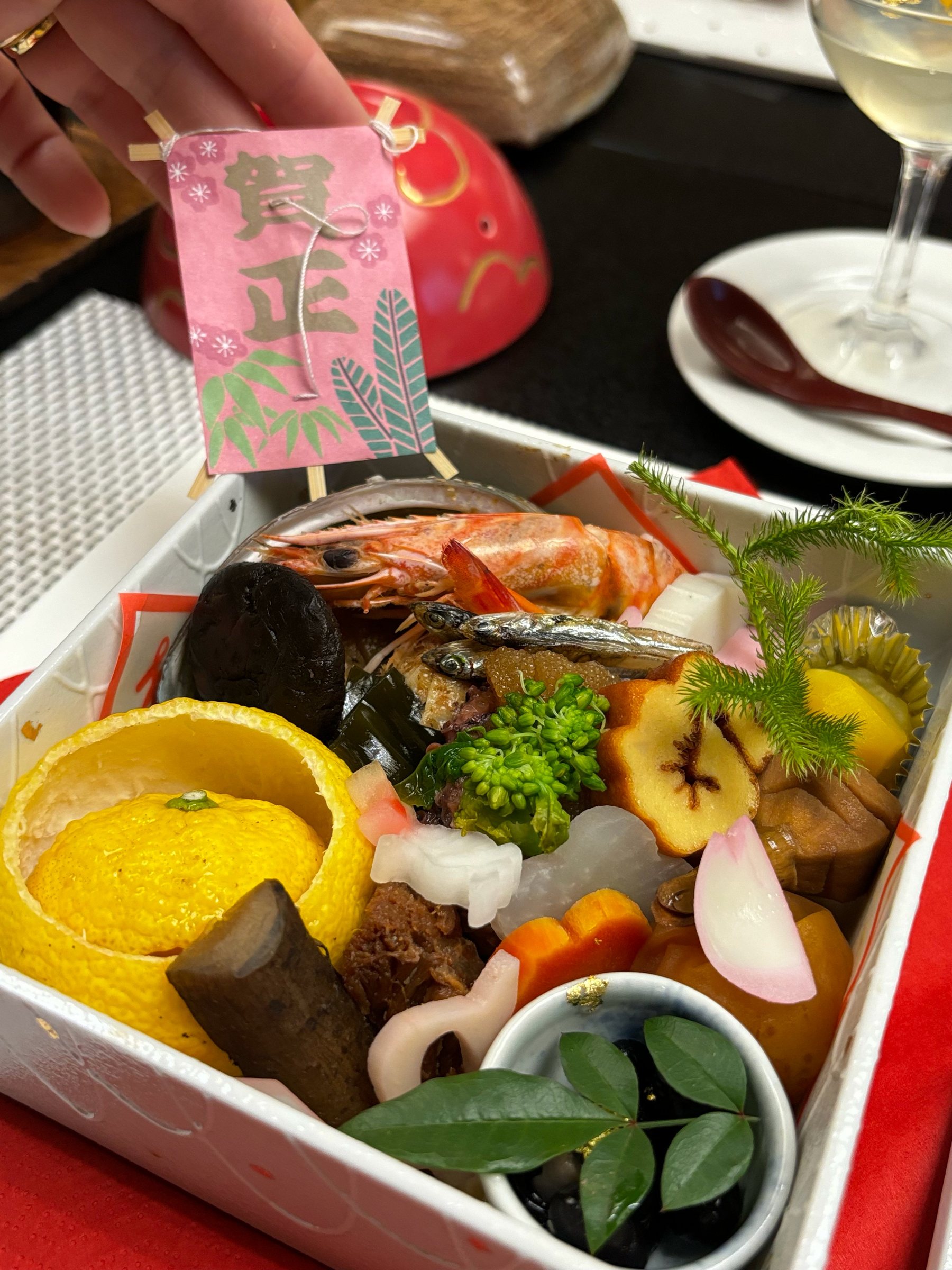
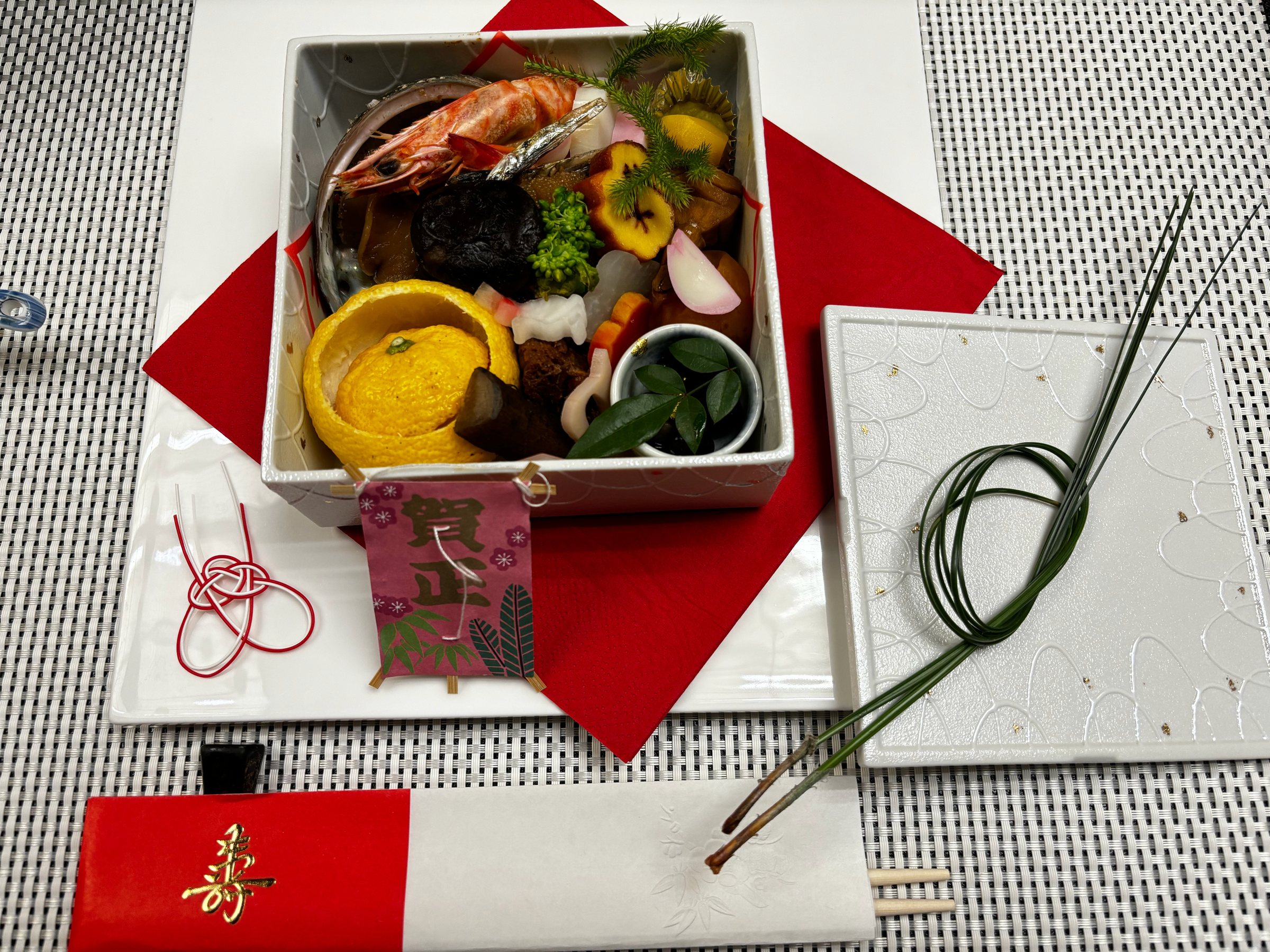
What caught the eye on the breakfast table on New Year’s Day was a white porcelain jūbako, a tiered food box, set on red and white paper. Beside it lay a chopstick envelope printed in gold with the character for “celebration” and a small kite reading “Gashō” (Happy New Year). The ryokan’s care for the seasonal calendar came through plainly.
Inside the box, auspicious foods were packed beautifully together:
– the glossy red of whole prawns, and the gleam of gold leaf on black beans; – the vivid yellow of a hollowed-out yuzu used as a cup; – datemaki (sweet rolled omelet), kuri kinton (sweet chestnut and mashed sweet potato), kazunoko (herring roe) and rape blossoms, all neatly fitted together without a gap.
Each piece was finished carefully in a single bite, and as a way of bringing the bright air of the New Year to the table it was very accomplished.
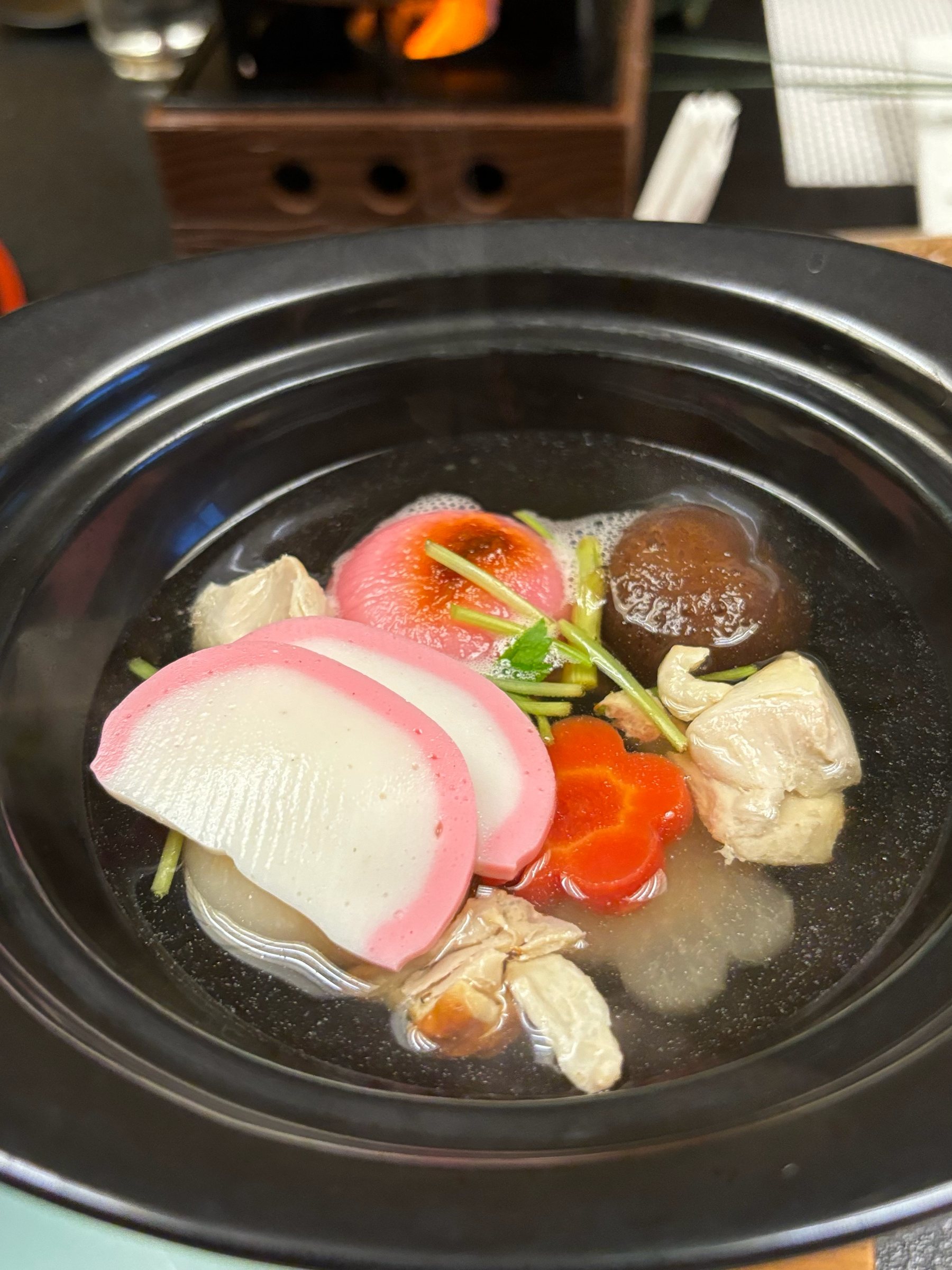
The star of New Year, ozōni, the celebratory soup with rice cakes, came piping hot. In a black lacquer pot sat red and white kamaboko, mochi, a flower-cut carrot, shiitake and chicken in good balance, with the green of mitsuba adding fragrance. We learned that in this region the broth for ozōni is clear, one more entry for our travel notebook.
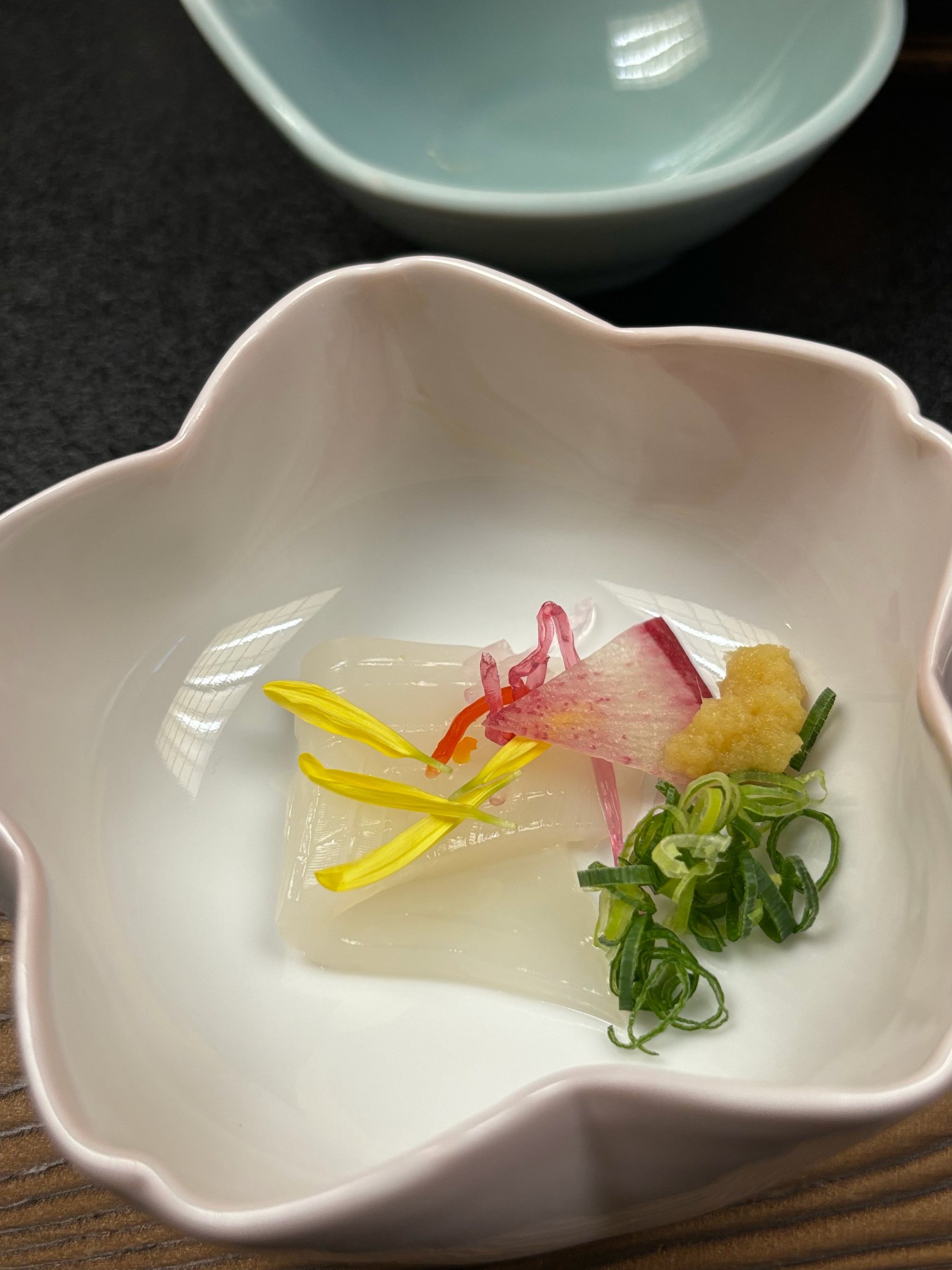
Squid sashimi, served even at breakfast in a well-judged portion.
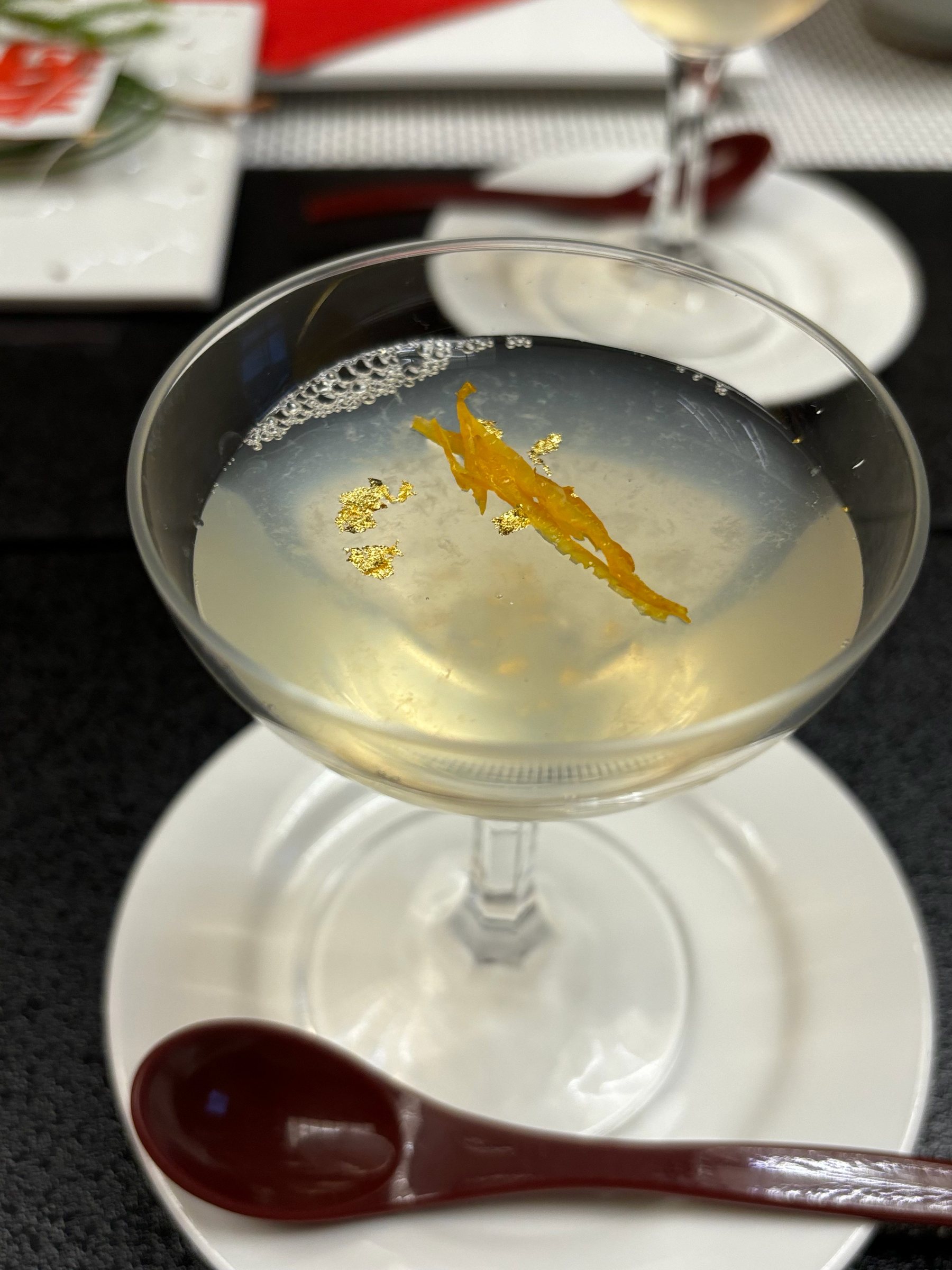
To finish, a house-made jelly in an elegant cocktail glass. Fine flakes of gold leaf drifted through the clear liquid, and a single sliver of citrus peel in the center gave off a fresh scent. With that refreshing taste, our New Year’s Day breakfast came to a thoroughly satisfying end.
Final thoughts
We visited on a special occasion, from New Year’s Eve into New Year’s Day.
Asanoya’s meals were superbly composed: traditional New Year motifs appeared throughout, while the flavors aimed for honest, straightforward deliciousness rather than novelty. From the festive presentation of the tiered box to the warmth of the ozōni and the small dishes that made the most of fresh ingredients, everything carried the ryokan’s philosophy of preparing in order to please its guests. From dinner through to breakfast, its hospitality made no compromises, and it proved once again the pride and ability of one of Yumura Onsen’s well-known ryokan.
Softening the skin in a traditional hot spring, and enjoying the polished staging of a very large property, are both part of the pleasure here.
This review reflects a visit over New Year 2023–24; please confirm current details, including seasonal menus, directly with Asanoya before visiting.